

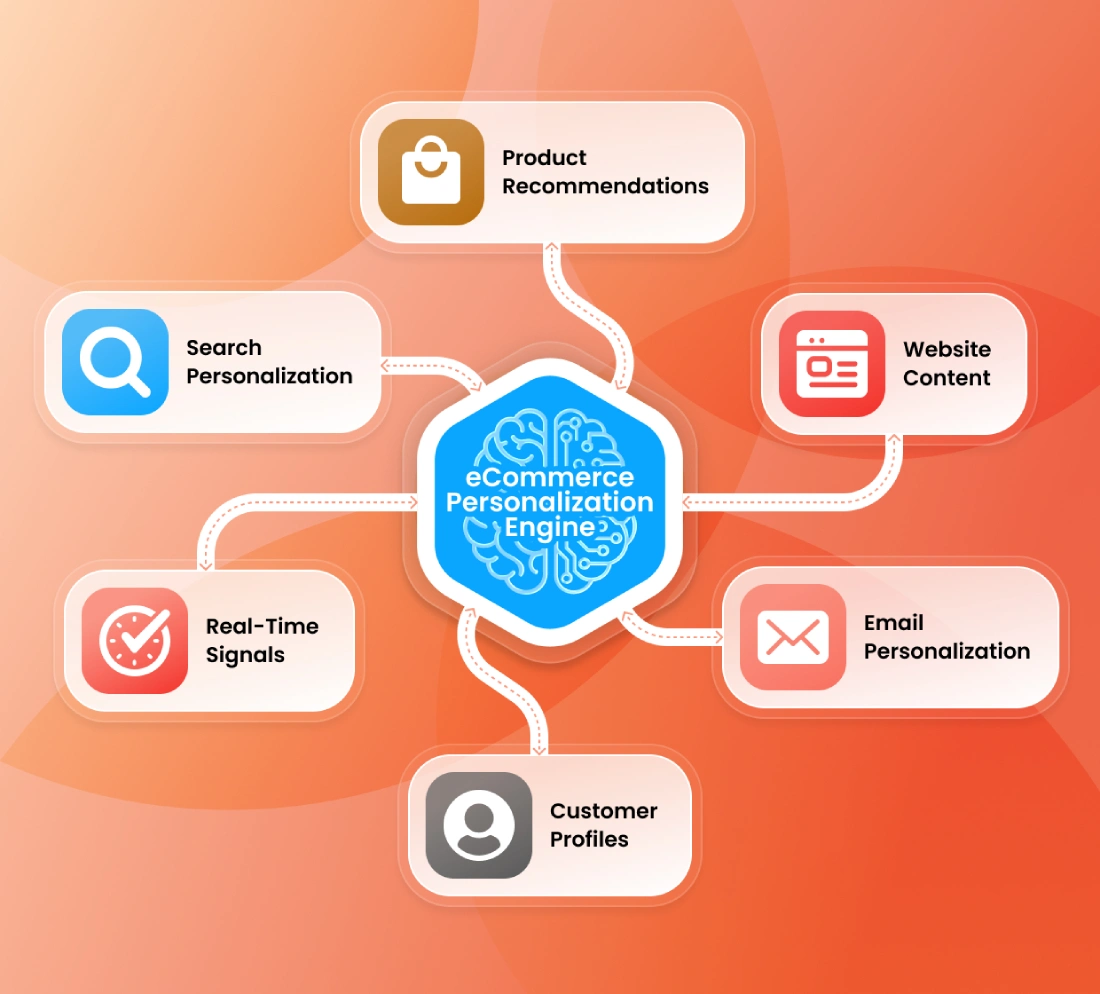
TL:DR for Ecommerce Personalization Software 

- Looking for the best ecommerce personalization software? Leading platforms in 2026 include Algonomy, Dynamic Yield, Nosto, Bloomreach, Insider, and Salesforce Personalization.
- The right solution should support personalized recommendations, search, content, customer journeys, and customer data activation.
- Platform selection should be based on business objectives, data readiness, integration needs, merchandising requirements, and scalability.
- Real-time decisioning, AI-driven personalization, and unified customer data are becoming essential capabilities for modern retailers.
- Retailers that successfully implement personalization can improve conversion rates, average order value, repeat purchases, retention, and customer lifetime value.
What Is Ecommerce Personalization Software?
Ecommerce personalization software helps online retailers adapt the shopping experience to each customer or customer segment. It uses signals such as browsing behavior, search intent, purchase history, product affinity, location, lifecycle stage, and stated preferences to decide what a shopper should see next.
Ecommerce Personalization is most useful when it makes the shopping journey easier, whether that’s through better recommendations, more relevant search results, dynamic content, or lifecycle messages that reflect customer behavior. A personalized ecommerce experience should feel helpful to the shopper, not like a layer of technology added on top of the site.
That could mean showing a returning customer products they are likely to buy again, changing homepage content based on category interest, ranking search results by shopper intent, or sending an email with product recommendations that reflect recent browsing behavior.
At its best, ecommerce personalization software helps shoppers make decisions faster while helping retailers improve conversion, basket size, repeat purchases, and customer lifetime value.
The goal is to make every interaction feel more useful, whether the shopper is browsing for the first time, returning to compare products, or coming back to buy again.
Top Ecommerce Personalization Software in 2026
The best ecommerce personalization software is not always the platform with the longest feature list. It is the one that fits the retailer’s use cases, data maturity, catalog complexity, and team workflows.
The best personalization for ecommerce should connect product discovery, content, search, customer data, and lifecycle engagement without creating more operational work for the team.
Leading Platforms Overview
The right ecommerce personalization software depends on what the retailer needs to solve first. Some platforms are strongest in onsite product recommendations. Some focus on search and product discovery. Others are built around journey orchestration, experimentation, or customer data.
The comparison below gives a practical view of leading ecommerce personalization tools in 2026.
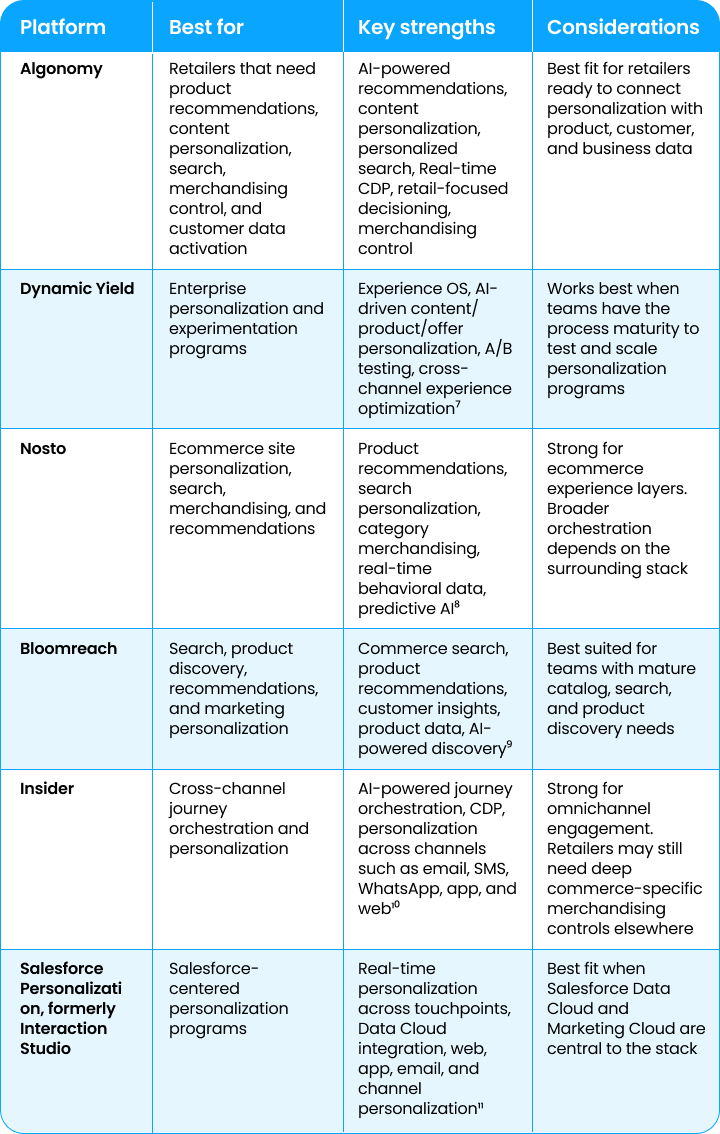

Algonomy is built for retailers that need personalization across the commerce lifecycle. Its Digital Experience Personalization products help teams personalize product discovery, recommendations, search, browse experiences, content, and shopper journeys.
Algonomy is a strong fit when personalization needs to reflect both customer intent and business priorities such as margin, inventory, brand rules, campaign goals, and product strategy.
Key strengths:
- Product recommendations and content personalization through Recommend™
- Personalized search through Find™
- Dynamic browse and navigation
- Customer data activation through Real-time CDP
- Support for merchandising rules, transparency, and reporting
- Cross-category use cases across fashion, beauty, grocery, electronics, B2B commerce, and marketplaces
Best for:
- Brands with large catalogs
- Retailers that need merchandising control
- Teams that want AI personalization tied to business goals
- Enterprise ecommerce retailers
- Companies looking to connect product, content, and customer data

Dynamic Yield by Mastercard offers personalization and experience optimization through Experience OS. Its ecommerce capabilities include product recommendations, personalized content, audience segmentation, A/B testing, and experimentation.
Key strengths:
- AI personalization
- A/B testing
- Content and product personalization
- Experience optimization
- Enterprise integrations
Best for:
- Enterprise teams with mature personalization programs
- Retailers focused on experimentation and experience optimization
- Brands that need multi-channel personalization and testing
Consideration:
Dynamic Yield is best suited for teams that can support a structured testing and optimization program.

Nosto is an ecommerce personalization platform focused on product recommendations, search personalization, category merchandising, segmentation, and on-site commerce experiences.
Best for:
- Ecommerce retailers looking to improve the onsite experience
- Teams focused on product recommendations and merchandising
- Shopify, Magento, and commerce-platform-led teams
Key strengths:
- Predictive product recommendations
- Search personalization
- Category merchandising
- Real-time behavioral data
- Ready-to-use recommendation algorithms
Consideration:
Nosto is strong for ecommerce experience personalization. Retailers with complex omnichannel data and activation needs should evaluate how it fits with their broader marketing and data stack.

Bloomreach offers commerce search, product discovery, recommendations, and personalization capabilities. Its product recommendation features use search history, customer insights, product data, and AI to personalize shopping experiences.
Best for:
- Retailers with large catalogs
- Teams prioritizing search and product discovery
- Businesses looking to connect product data and customer behavior
Key strengths:
- Search-led personalization
- Customer and product data
- AI-powered discovery
- Merchandising use cases
- Product recommendations
Consideration:
Bloomreach is especially useful when product discovery, search, and merchandising are central to a personalization strategy.

Insider focuses on AI-powered customer journey orchestration and channel-wide personalization. Its platform supports customer data unification and journeys across web, app, email, SMS, WhatsApp, TikTok, and other channels.
Best for:
- Brands focused on cross-channel customer engagement
- Lifecycle and CRM teams
- Marketers managing many digital channels
Key strengths:
- Journey orchestration
- Omnichannel messaging
- Unified customer data
- Merchandising use cases
- Broad channel support
Consideration:
Insider is well-suited for journey orchestration. Retailers should assess whether they also need deeper commerce-specific controls for search, recommendations, merchandising, and catalog-driven personalization.

Personalization, Formerly Interaction Studio
Insider focuses on AI-powered customer journey orchestration and channel-wide personalization. Its platform supports customer data unification and journeys across web, app, email, SMS, WhatsApp, TikTok, and other channels.
Best for:
- Businesses already using Salesforce Data Cloud or Marketing Cloud
- Teams that need real-time personalization across Salesforce-managed touchpoints
- Enterprises looking for personalization within the Salesforce ecosystem
Key strengths:
- Real-time 1:1 personalization
- Data Cloud integration
- Web, app, email, and channel personalization
- Customer profile activation
Consideration:
Salesforce Personalization is strongest when Salesforce is already central to the customer data and marketing technology stack.
Why Algonomy Is a Leader in Ecommerce Personalization
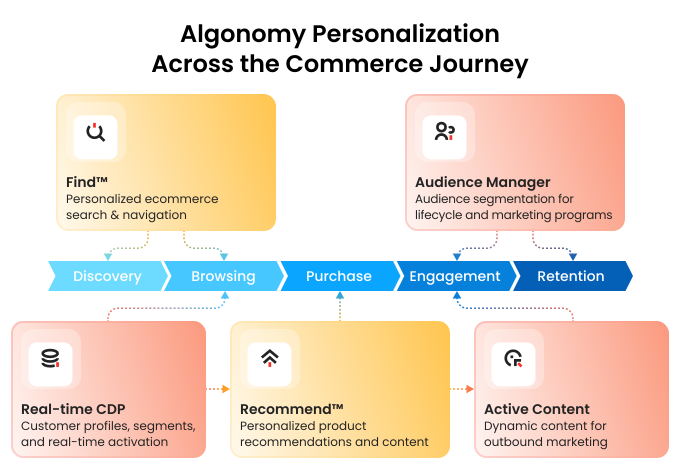
AI-Powered Personalization Engine
Retail personalization needs more than static product carousels. Retailers need to understand shopper intent, product relationships, catalog context, inventory, pricing, margins, and merchandising goals simultaneously.
Recommend™ helps retailers personalize product recommendations and content based on shopper behavior, context, and business priorities. It supports use cases such as cross-sell, upsell, bundles, replenishment, personalized content, guided selling, and dynamic experiences.³
Matas shows this in practice. The health and beauty retailer used Algonomy Recommend™ across web, mobile, and email, achieving 36% year-over-year growth in attributable sales, a 49% increase in orders via recommendations, and a 38% increase in items sold via recommendations.
Must explore how eXtra achieved 52% higher AOV with Algonomy
Real-Time Decisioning
Personalization works best when decisions happen while shopper intent is still fresh.
A customer who searches for a product, views a category, adds an item to the cart, or returns after a previous session is giving useful signals. Real-time decisioning helps the retailer respond with the right product, content, offer, or message.
Algonomy’s personalization approach is built around this idea. Recommendations, content, search, and customer data can respond to live behavior while still respecting business rules and merchandising goals.
Composable CDP Advantage
Personalization becomes stronger when it is connected to a customer data foundation.
Real-time CDP helps retailers unify customer data, resolve identities, build customer profiles, create audiences, and activate insights across channels. It supports real-time and batch data ingestion, identity resolution, retail-focused analytical models, audience activation, and connectors across online and offline systems.⁶
Proven Business Impact
Algonomy case studies show how this can work across retail categories. Matas grew attributable sales from recommendations by 36% year over year, while Algonomy Recommend™ supports use cases across fashion, beauty, grocery, electronics, and other retail categories.
Matas grew attributable sales
with personalized recommendations

36%
YoY growth in attributable sales
49%
Increase in orders via recommendations
38%
Increase in items sold via recommendations
Powered by Algonomy Recommend™
How to Choose the Right Ecommerce Personalization Software
Step 1: Define Business Goals
Start with the outcome you want to improve.
Common goals include:
- Increase Conversion Rate
- Improve Average Order Value
- Reduce Cart Abandonment
- Increase Repeat Purchases
- Improve Product Discovery
- Personalize Email and Lifecycle Campaigns
- Increase Loyalty Engagement
- Improve Search Relevance
- Support Omnichannel Journeys
Step 2: Assess Data Readiness
Personalization depends on usable data.
Before choosing software, assess whether you have access to product catalog data, inventory data, pricing and promotion data, customer profiles, purchase history, etc. The platform should help you improve data quality, unify signals, and activate them in practical ways.
Step 3: Evaluate Integrations
Ecommerce personalization software should fit into your existing technology stack.
Check integrations with:
- Ecommerce Platform
- Customer Data Platform
- Product Information Management System
- Enterprise Resource Planning System
- Improve Product Discovery
- Search
- Email Service Provider
- Improve Search Relevance
- Support Omnichannel Journeys
- Marketing Automation
- Analytics
- Loyalty Platform
- Paid Media Platforms
- Content Management System
- Data Warehouse
The right platform should reduce operational friction, not create another isolated system.
Step 4: Compare Features and Vendors
Compare vendors based on the capabilities that matter most to your use cases.
Important questions include:
- Does the platform support real-time personalization?
- Can it personalize recommendations, search, content, and email?
- Does it support anonymous and known users?
- Can merchandisers control business rules?
- Does it explain why recommendations were shown?
- Can teams test different strategies?
- Does it support customer data activation?
Step 5: Test Before Scaling
Good starting use cases for testing include:
- Homepage Recommendations
- PDP Cross-Sell
- Cart Page Recommendations
- Personalized Search Results
- Browse Abandonment Email
- Replenishment Reminders
- Dynamic Email Content
- Loyalty Audience Targeting
- Personalized Category Pages
Challenges in Ecommerce Personalization and Solutions
Ecommerce personalization can create real value, but it also exposes gaps in data, process, and technology. Most challenges come from disconnected systems, unclear ownership, poor data quality, or tools that are too hard for business teams to use.
Data Silos
Data silos make personalization inconsistent. A retailer might have browsing data in one system, purchase history in another, loyalty data in another and email engagement on a separate platform.
This results in fragmented experiences. A customer might receive irrelevant recommendations, repeated offers or messages that don’t take into account recent behavior.
This is solved by a unified customer data foundation. A real-time CDP can unify customer signals, resolve identities, build customer profiles and activate segments across channels.
Privacy and Compliance
Customers desire relevant experiences, but they also want to know their data is being used responsibly. Personalization can be uncomfortable when a brand uses data without clear consent, transparency or customer value.
Solution: Start with consent-first personalization. Only collect the data you need. Respect customer preferences. Apply governance.Make the benefit clear to the customer.
Poor Data Quality
Bad data leads to bad personalization. Incomplete product attributes, duplicate customer profiles, inconsistent taxonomy, and stale inventory can all make recommendations and messages less useful.
Solution: Strengthen data governance and validation. Retailers need clean product data, reliable identity resolution, current inventory, and recommendation logic that reflects what is actually available to sell.
Lack of Real-Time Capabilities
Personalization suffers when data is delayed. If a platform can’t act fast on a shopper’s current session activity, the brand may miss the moment of peak intent.
Solution: Leverage real time decisioning. Personalization should be responsive to live signals such as searches, clicks, cart activity, product views and campaign engagement.
Cookieless Personalization
Some personalization programs fail because the tools are too difficult for business users to use. If development support is needed for every change, then marketers and merchandisers move slowly.
Solution: Choose a platform that supports business workflows. Teams need clear controls, reporting, rules and configuration options so they can move without waiting for long development cycles.
Emerging Trends in Ecommerce Personalization
Ecommerce personalization is headed toward predictive, privacy-centric and data-connected experiences. AI, first-party data, real-time decisioning and more transparent customer relationships will define the next wave.
AI & Predictive Personalization
AI is enabling retailers to move from reactive personalization to predictive personalization.
Rather than simply responding to what a shopper did in the past, systems can predict likely next products, churn risk, replenishment timing, intent and preferred channels.
What retailers value is timing. The recommendation, offer or message is more valuable when it is delivered when the shopper is most likely to take action.
Hyper-Personalization
Hyper-personalization leverages real-time behavior, customer, and product data, along with AI, to tailor experiences at a more individual level.
A few examples are unique product recommendations for each shopper, personalized search rankings, or dynamic content based on current intent.
Generative AI in Commerce
Generative AI is starting to change how retailers create content and guide shoppers. It works best when it is grounded in accurate product data, customer context, inventory, and business rules. Without that foundation, it may produce content that sounds helpful but does not support a reliable shopping decision. It can support use cases such as conversational shopping assistants, guided selling journeys or AI-generated product bundles.
Zero-Party Data
Zero-party data is information that customers choose to share with a brand. This may include preferences, sizes, interests, needs, budget, communication choices, or shopping goals.
For example, a beauty shopper shares skin type, or a fashion shopper shares preferred sizes.
Zero-party data works best when customers see clear value in sharing it.
Cookieless Personalization
For years, many brands relied on third-party cookies to understand shoppers across the web. That approach is becoming less dependable.
Cookieless personalization works differently. It uses the data a retailer collects through its own customer relationships, such as website behavior, purchases, loyalty activity, email engagement, app activity, and stated preferences.
Conclusion: Personalize to Compete and Win
For retailers, an ecommerce personalization software can improve conversion, average order value, retention, and customer lifetime value when it is tied to clear goals and measured carefully. Algonomy’s capabilities help retailers create relevant, real-time, and business-aware experiences across the customer journey.
Build ecommerce personalization around the full customer journey
Algonomy helps retailers create relevant, real-time, and business-aware experiences across product discovery, search, content, customer data, and lifecycle engagement.
FAQs
1. What is ecommerce personalization software?
Ecommerce personalization software helps retailers adapt shopping experiences using customer data, product data, behavioral signals, and AI. It can personalize recommendations, search results, website content, email content, offers, and omnichannel journeys.
2. How does personalization increase conversion rates?
Personalization can increase conversion rates by helping shoppers find relevant products and content faster. When recommendations, search results, offers, and messages match shopper intent, customers have fewer steps between interest and purchase.
3. What data is required for personalization?
Common data includes browsing behavior, search behavior, purchase history, cart activity, product catalog data, inventory, pricing, customer profiles, loyalty data, email engagement, and stated preferences.
4. Is personalization safe for user privacy?
Personalization can be privacy-safe when retailers use clear consent, responsible data collection, preference management, governance, and transparency. Customers should understand how their data improves the experience and should be able to manage their choices.
5. What is the best personalization software?
The best personalization software depends on business goals, use cases, data maturity, and technology stack. Leading ecommerce personalization platforms include Algonomy, Dynamic Yield, Nosto, Bloomreach, Insider, and Salesforce Personalization.
6. How does AI improve personalization?
AI improves personalization by identifying customer intent, predicting likely needs, ranking products, selecting content, optimizing offers, and adapting experiences in real time. It helps retailers move beyond fixed rules while still supporting business controls.
7. What industries benefit most from personalization?
Retail and fashion, grocery, beauty, electronics, marketplaces, travel, hospitality, and B2B ecommerce can all benefit from personalization. It is especially useful for businesses with large catalogs, repeat customer interactions, or complex buying journeys.
Sources
- McKinsey & Company. 2023. “What Is Personalization?” McKinsey Explainers.
- McKinsey & Company. 2021. “The Value of Getting Personalization Right – or Wrong – Is Multiplying.”
- Dynamic Yield by Mastercard. “Market-Leading Personalization Software.” Mastercard.
- Nosto — AI-Powered Ecommerce Personalization.
- Bloomreach. “Product Recommendations.” Bloomreach Discovery.
- Insider. “AI-Powered Customer Journey Orchestration.” Insider One.
- Salesforce. “Real-Time Personalization Engine.” Salesforce Marketing.