



TL;DR: Optimizing Product Discovery in Fashion Ecommerce
How do you optimize product discovery in fashion ecommerce?
You can optimize product discovery in ecommerce by building one connected discovery experience across Find™, Recommend™, Social Proof Optimize, and Agentic Commerce. Each layer plays a distinct role, and together they reduce early drop-off before shoppers reach PDPs. That means:
- high-intent search that recovers from messy queries (typos, synonyms, vague terms),
- browse experiences that guide choices quickly (personalized product listing pages, i.e., PLPs),
- confidence signals in the moments of hesitation (social proof messaging and badging), and
- guided assistance for uncertain shoppers that asks 1–2 clarifying questions, then returns a tight shortlist with “why this matches.”
Done right, discovery stops leaking intent before shoppers ever reach product detail pages (PDPs). This matters because ecommerce teams can spend heavily to acquire traffic, but still lose it early. And even after shoppers add items to their cart, industry benchmarks show ~70% cart abandonment1, making every recovered “intent moment” upstream even more valuable.
Key Takeaways:
- Shoppers who use search are typically higher intent and convert at meaningfully higher rates than browsers, so search should be viewed as a revenue lever.
- “No results” pages are a major leak: Baymard’s research finds 68% of sites3 have “no results” experiences that are essentially dead ends.
- Fashion discovery needs guidance, not just relevance (size/fit, style intent, occasion, budget), and that’s where recommendations, social proof, and conversational/agentic help compound.
- Optimize discovery with a tight measurement loop: Search-to-PDP rate, zero-results recovery, PLP CTR, and add-to-cart downstream impact.

Fashion ecommerce is won or lost in the first few minutes of a session. When shoppers cannot quickly find a relevant shortlist, they abandon their intent. This guide breaks down ecommerce discovery optimization for fashion retailers, with practical moves across search, category browsing, recommendations, proof cues, and guided assistance that improve conversion without leaning on blanket discounting.
If you’re curious where your site is currently losing revenue, start with a quick teardown to uncover hidden opportunities across discovery, recommendations, and checkout.
What is Product Discovery in Ecommerce?
Product discovery in ecommerce is how shoppers find and narrow down items through site search, category browsing (PLPs), navigation, and decision support such as recommendations and proof cues. The goal is simple: help shoppers reach a confident shortlist quickly, especially in fashion where intent is often broad, visual, and occasion-led.
“If shoppers cannot find what they want, they cannot buy it.”2
— Baymard Institute, E-Commerce Search UX Research
In this guide, “discovery optimization” refers to improving that entire system end-to-end: relevance, recovery, guidance, confidence, and assisted journeys.
Why Ecommerce Discovery Optimization Matters in 2026 (Especially in Fashion)
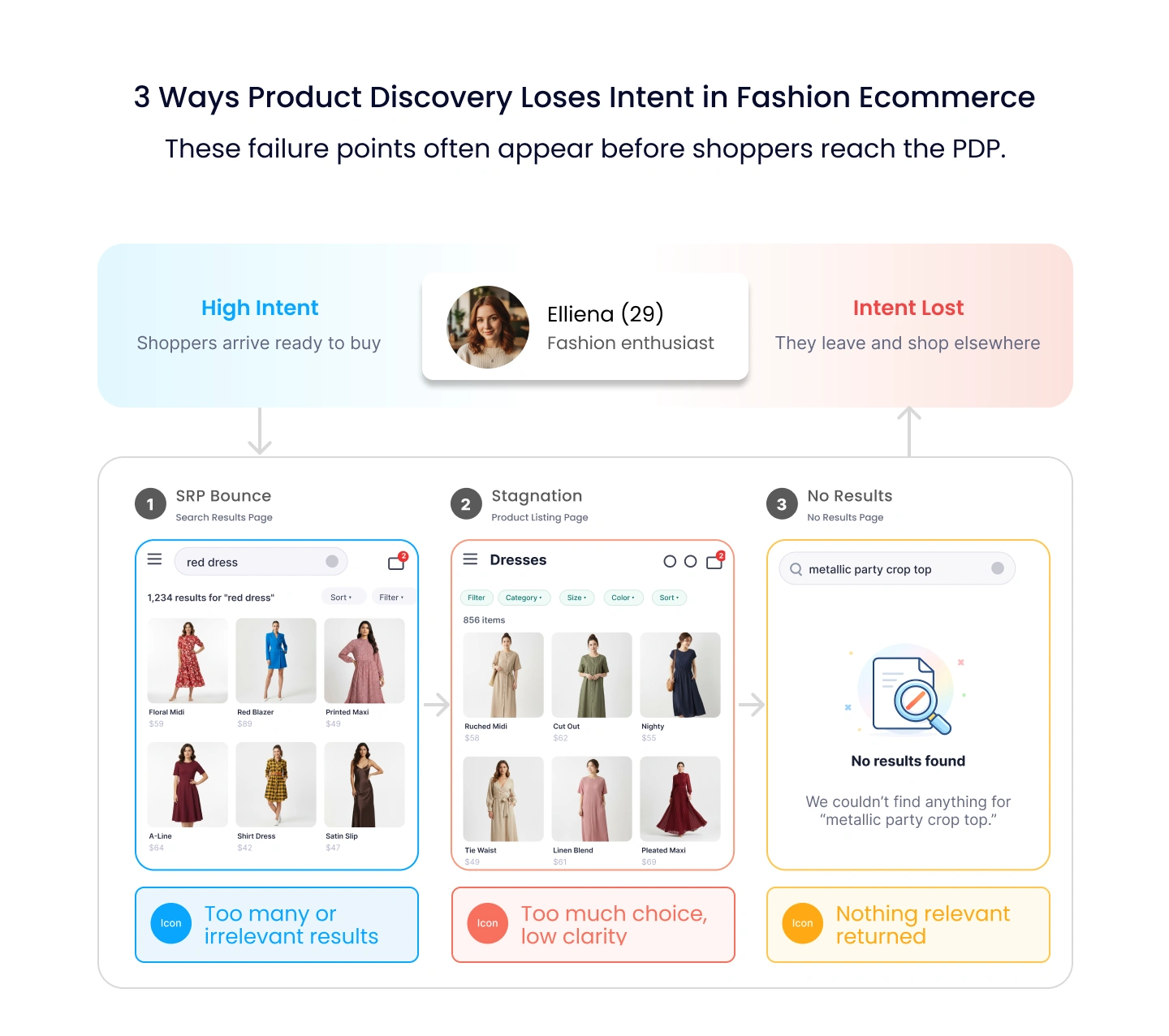
Fashion shoppers don’t browse like they used to. They mix vague inspiration with specific intent, and then expect the site to “get it.” When discovery fails, they simply leave.
Two macro shifts make discovery optimization more urgent now:
1. More intent is compressed into fewer interactions.
AI-driven shopping journeys are accelerating. Shopify describes “agentic shopping” as agents that can search, compare, and even complete checkout on a buyer’s behalf, inside a conversation.4
What this means for fashion retailers: Your product data, search, and discovery relevance must work not just for humans but also for machine-assisted journeys.
2. The cost of wasting traffic is higher.
Benchmarks show cart abandonment remains around 70% on average, meaning the few shoppers who do express intent are disproportionately valuable, and losing them earlier in the discovery process is even more expensive.
What this means for fashion retailers: For fashion teams specifically, discovery is also where fit anxiety, style uncertainty, and too much choice first show up on SRPs and PLPs.
Discovery Optimization in Fashion: How It Works
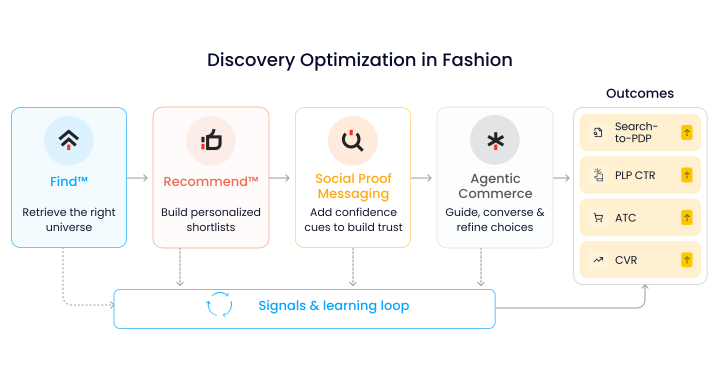
In fashion ecommerce, product discovery breaks down for predictable reasons: vague intent, too many similar options, fit and styling uncertainty, and low confidence in what is worth clicking. A modern personalization platform solves these issues by combining four capabilities: Find™ (a personalized search engine for retrieval), Recommend™ (a product recommendations engine that builds shortlists), Social Proof Optimize (confidence cues), and Agentic Commerce (guided, conversational refinement). Together, they form a practical set of ecommerce personalization solutions for enhanced product discovery.
1 Find™: Interpret shopper intent and return the right universe fast
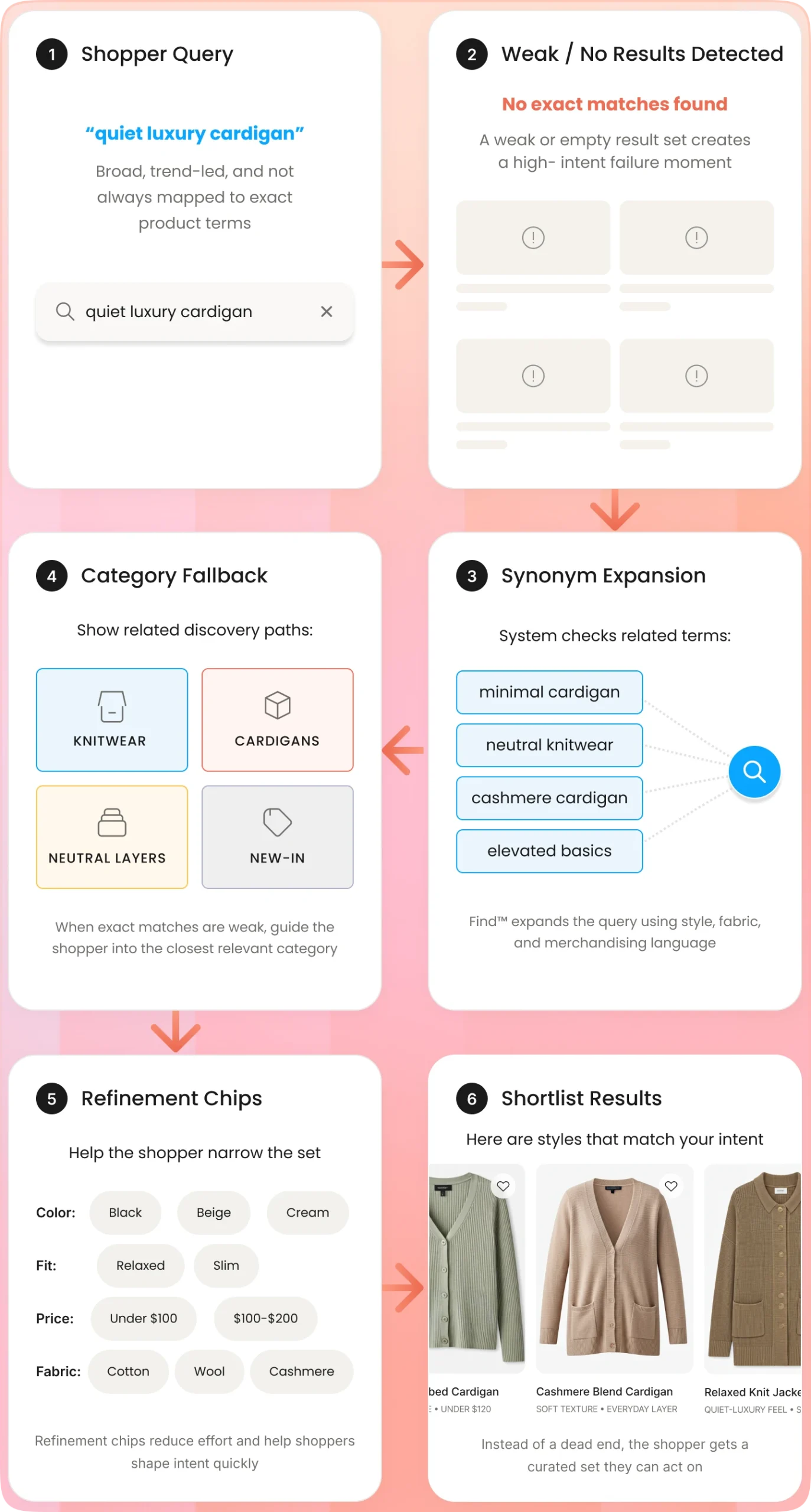
Queries can be broad (“date night outfit”) or incomplete (“black linen oversized”), and shoppers expect the site to understand the intent. Find™ is the layer that turns messy intent into relevant retrieval across search and browse — handling variants, synonyms, misspellings, and category intent. This plays a critical role in product discovery in ecommerce by improving search relevance and reducing dead ends.
Fashion example:
A shopper searches “wedding guest dress” → Find™ should surface the right occasionwear assortment, prioritize available sizes, and elevate relevant attributes (length, fabric, color) so the shopper can refine without friction.
 What “good” looks like: fewer dead ends, better first-page relevance, higher Search-to-PDP and PLP CTR.
2 Recommend™: Convert relevance into a confident shortlist
Even when Find™ returns relevant results, shoppers stall because the set is too big. Recommend™ is how you move from “results” to “shortlist” by guiding the next click based on context: what the shopper is browsing, what typically goes together, and what reduces decision effort.
Fashion example:
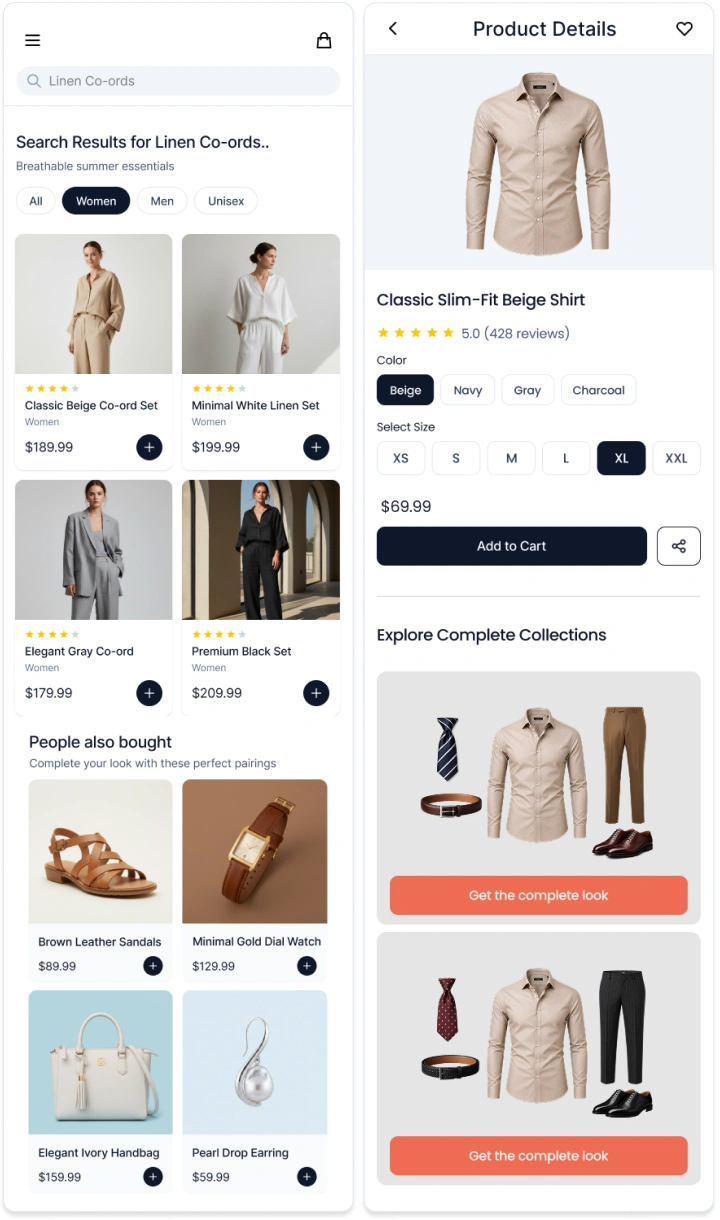
- On a PLP for “linen co-ords”, RecommendTM surfaces practical and stylish add-ons that other people bought along with the clothing.
- On a PDP for a shirt, Ensemble AI, powered by RecommendTM, can show “complete the look” combinations made up of complementary pieces (trousers, belts, etc.)
What “good” looks like: less pogo-sticking between PLP and PDP, more PDP depth, higher add-to-cart. AI-powered recommendations are a core part of ecommerce product discovery.
3 Social Proof Optimize: Add confidence cues during discovery
Discovery is where doubt begins: “Is this popular?” “Will this sell out?” “Is it worth clicking?” Social Proof Optimize helps reduce uncertainty by placing credible, contextual proof signals where they matter most: SRP, PLP, and PDP.
Fashion example:
On SRP/PLP: “Bestseller,” “Trending in Dresses,” “Popular in your size.” On PDP: review volume + rating, “X bought today,” “Selling fast.” On PLP during seasonal edits: “Most saved this week” to validate trend intent.
What “good” looks like: improved click-through to PDP, faster decisions, better PDP-to-cart. Social proof improves ecommerce product discovery by increasing shopper confidence during browsing.
4 Agentic Commerce: Turn discovery into a conversation that refines intent
Fashion shoppers often know the goal but can’t express the query (“I need a beach wedding outfit” / “I want quiet luxury but affordable”). Agentic Commerce acts as the discovery guide: it asks clarifying questions, applies constraints, and produces a curated set — while staying inside the shopping journey.
Fashion example:
“Find me a black dress under $150 for a dinner date, shipping by Friday.” The agent clarifies silhouette, fit, and occasion preferences, then narrows to a handful of high-fit options and explains why each matches.
What “good” looks like: fewer refinements, higher conversion for first-time/uncertain shoppers, shorter time-to-shortlist. This represents the next evolution of ecommerce product discovery, where AI actively guides users.
5 Orchestration: Make the four layers work together
The conversion lift comes from orchestration: Find™ gets you into the right set, Recommend™ narrows the set, Social Proof Optimize boosts confidence to click/commit, and Agentic Commerce resolves ambiguity when shoppers can’t self-serve.
A practical orchestration loop (Fashion):
- Broad query → Find™ returns a relevant assortment
- SRP/PLP → Social Proof Optimize increases click confidence
- PDP → Recommend™ builds an outfit context + alternatives
- Stalled shoppers → Agent asks 1–2 questions to finalize a shortlist
- Measure end-to-end: Search-to-PDP → PDP engagement → ATC → CVR (by segment)
Find Hidden Revenue Opportunities in Your Ecommerce Experience
Many ecommerce sites lose revenue daily due to generic experiences, ineffective product discovery, and missed cross-sell moments.
We are offering a free RPV Lift Teardown, in which we’ll analyze your site to identify exactly where revenue is leaking.
You’ll receive annotated screenshots of missed opportunities and a 90-day personalization uplift plan for FREE.
Best Practices for Product Discovery in Ecommerce (Step-by-Step)
1 Build an intent map for fashion discovery (Find™)
Create a simple dictionary of how shoppers search and browse: occasion (wedding guest), silhouette (midi slip), fabric (linen), style vibe (quiet luxury), and fit terms. Use it to improve a personalized search engine that handles synonyms, typos, and attribute-led refinement.
2 Treat “no results” and “weak results” as high-intent moments (Find™ + Agentic Commerce)
Add recovery paths such as alternative categories, smart fallbacks, and refinement chips. When intent is still unclear, introduce a lightweight agent prompt that asks one clarifying question and then narrows the set.
3 Use a product recommendations engine to reduce choice fatigue (Recommend™)
Replace generic carousels with personalized product recommendations that match the decision stage: “complete the set” on PLPs, “style with” on PDPs, “similar fit” when shoppers bounce, and “frequently bought together” for practical add-ons. This is how an ecommerce product recommendation engine becomes a discovery accelerator.
4 Add confidence cues where discovery friction shows up (Social Proof Optimize)
Use proof signals on SRPs and PLPs to improve click confidence, then reinforce on PDPs to support add-to-cart. Keep signals selective and accurate so they feel believable in fashion, where brand trust matters.
5 Deploy Agentic Commerce for shoppers who cannot express the right query
When shoppers circle between PLP and PDP or keep refining searches, offer an agent flow that captures constraints such as occasion, budget, shipping timeline, and fit preference. Return a small shortlist and explain the match in one line.
6 Orchestrate the system and measure it end-to-end
Discovery improvements compound when Find™, Recommend™, Social Proof Optimize, and Agentic Commerce work together as AI-powered personalization. Track Search-to-PDP rate, PLP CTR, recovery rate from weak results, PDP engagement, add-to-cart, and conversion. Treat it like an operating loop, not isolated page metrics.
Measuring Ecommerce Product Discovery Performance
Once discovery is orchestrated across Find™, Recommend™, Social Proof Optimize, and Agentic Commerce, the next question is simple: is the experience helping shoppers move forward?
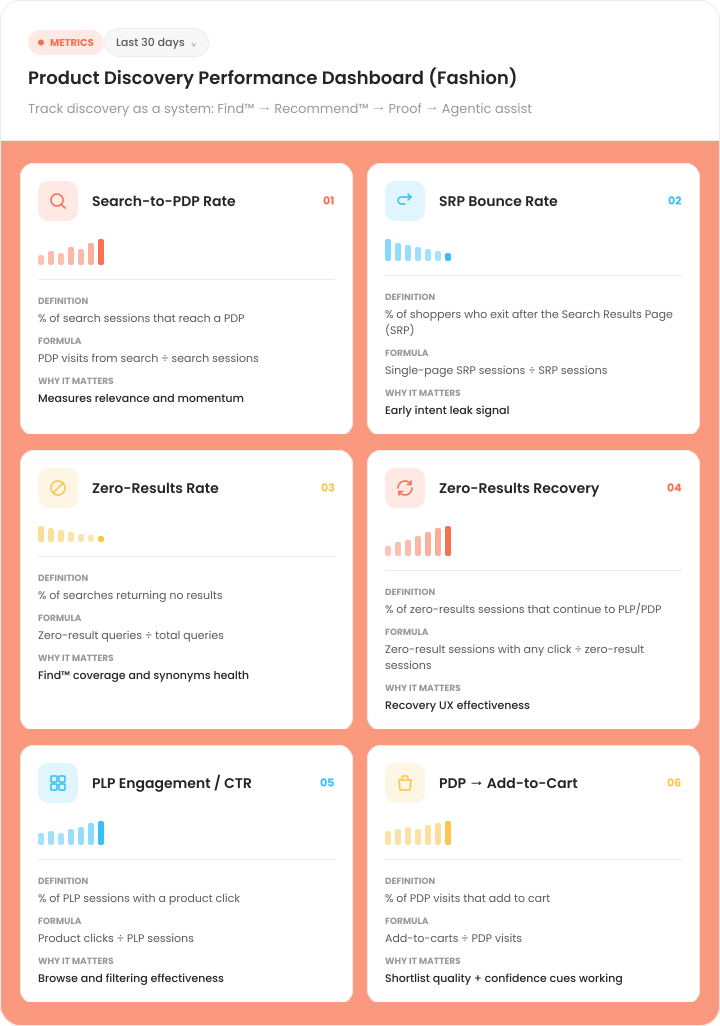
A discovery dashboard should track where intent is gained, slowed, or lost across the journey. For fashion retailers, that means looking beyond overall conversion rate and measuring the signals that show whether shoppers are finding relevant products, engaging with PLPs, recovering from weak results, and adding shortlisted items to cart.
Common Mistakes to Avoid for Optimized Ecommerce Product Discovery
Most fashion retailers run into the same pitfalls when improving product discovery in ecommerce. Here is what to watch for:
Treating Search as a feature instead of a journey
If search and category browsing are not tuned to fashion language and real shopping intent, shoppers hit dead ends early and never reach PDPs in a high-quality state.
Shipping recommendations that add noise
When personalized product recommendations repeat what a shopper has already seen or ignore context, they slow decision-making. A strong product recommendations engine narrows options, offers alternatives, and helps shoppers build an outfit or set.
Overusing badges and proof cues
If every item is labeled as trending or selling fast, the cues lose meaning and can reduce trust. Use fewer signals, validate them with real behavior, and place them where shoppers hesitate.
Personalization that breaks predictability
An AI-powered personalization approach still needs consistency. If PLPs reshuffle too aggressively or filters feel unstable, shoppers feel lost. Keep the experience explainable and stable.
Waiting too long to assist shoppers who are uncertain
Repeated refinements, PLP-to-PDP bouncing, and broad queries are signals to introduce guided help. Agentic flows work best when they shorten the path to a confident shortlist.
Measuring discovery in isolation
CTR alone can look healthy while add-to-cart stays flat. Track discovery as a system: Search-to-PDP, PLP CTR, PDP engagement, add-to-cart, and conversion by segment.
Expert Perspective on Optimizing Product Discovery in Fashion Ecommerce
Discovery is where fashion revenue is won, because the fastest path to conversion is helping shoppers find the right shortlist, not more products.
Arjun Kunnath
Principal Product Marketing Manager, Algonomy
What this means in practice: the highest ROI discovery work isn’t a flashy redesign. It’s fixing the invisible failure points — weak results, dead-end recovery, low-quality ranking, and generic PLPs — then layering guidance (recommendations) and confidence (social proof) in the moments of hesitation.
What Are the Best Tools for Ecommerce Product Discovery?
The best ecommerce product discovery tools help retailers improve search relevance, personalization, and guided shopping experiences.
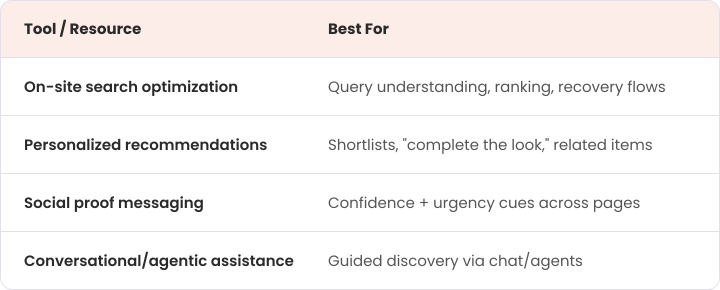
Note: Your stack choice should align with your operating model (merch control + AI optimization) and the speed at which you need to ship improvements. These tools are essential for executing ecommerce product discovery optimization strategies at scale.
Discovery Optimization in a Nutshell
Optimizing Discovery is the fastest way to improve ecommerce performance because it fixes intent leaks before shoppers ever reach the PDP. In fashion, the winning approach is a system: search that interprets intent, recovery that avoids dead ends, PLPs that guide decisions, and confidence cues that reduce doubt. Benchmarks like persistent cart abandonment around ~70% remind us how valuable every upstream “intent moment” is.
THE BOTTOM LINE
If shoppers can’t find the right product fast, nothing else in the funnel matters.
Ready to improve product discovery for your fashion shoppers?
See how Find™, Recommend™, Social Proof Optimize, and Agentic Commerce work together to lift discovery-to-cart performance.

Frequently Asked Questions
1. What are the best tools for ecommerce product discovery?
The best tools for ecommerce product discovery combine a personalized search engine (Find™), a product recommendations engine (Recommend™), confidence cues such as Social Proof Optimize, and guided help like Agentic Commerce. Together, these act as ecommerce personalization solutions that improve search-to-PDP rate, PLP engagement, and add-to-cart.
2. What are ecommerce product discovery optimization strategies?
The highest-impact strategies include improving weak/no-results recovery, upgrading autocomplete and suggestions, optimizing PLP filtering and sorting for decision drivers, using personalized product recommendations to create shortlists and outfit context, adding credible proof cues on SRP/PLP/PDP, and using agentic prompts to refine intent when shoppers stall.
3. What is product discovery ecommerce and how does it work?
Product discovery in ecommerce refers to how shoppers find and narrow products through search, category browsing, and guided decision support. It works when relevance (Find™), guidance (Recommend™), confidence (Social Proof Optimize), and assisted refinement (Agentic Commerce) combine into one coherent discovery flow.
4. How do you improve product discovery in ecommerce for fashion?
Improve product discovery in ecommerce by combining Find™ (retrieval and relevance), Recommend™ (shortlists and outfit context), Social Proof Optimize (confidence cues), and Agentic Commerce (guided refinement). Measure impact through Search-to-PDP rate, PLP CTR, PDP engagement, add-to-cart, and conversion by segment.
5. What is the difference between ecommerce site search optimization and product discovery optimization?
Ecommerce site search optimization focuses on the search box, queries, ranking, and the search results page. Product discovery optimization includes site search, category browsing (PLPs), navigation, filtering, sorting, and on-page guidance that helps shoppers move from exploration to decision.
6. What is the difference between Find™ and Recommend™ in product discovery?
Find™ helps shoppers locate the right universe of products (retrieval + relevance) based on intent signals. Recommend™ helps shoppers choose within that universe by creating shortlists, alternatives, “complete the look,” and context-aware suggestions that reduce decision fatigue.
7. Where should social proof show up in the discovery journey — PLP, PDP, or checkout?
The best place for social proof depends on the decision stage. In discovery, social proof can lift clicks on SRPs and PLPs (e.g., bestsellers, trending, “most saved”), while PDP proof builds confidence to add to cart (ratings/reviews, contextual velocity cues). Checkout proof should be minimal and reassurance-led.
8. What is agentic commerce in ecommerce discovery?
Agentic commerce is when an AI assistant helps shoppers discover products by understanding intent, asking clarifying questions, applying constraints (budget, size, delivery date), and returning a curated shortlist — often with reasons why each option fits.
9. How long does it take to improve ecommerce discovery optimization performance?
Most teams can improve key discovery metrics in 2–6 weeks by fixing high-impact failure points (no/weak results recovery, better suggestions, clearer PLP filtering). Larger changes — like deeper ranking/personalization models and orchestrated experiences — often take 6–12 weeks, depending on data quality and release cycles.
10. Is product discovery optimization worth it for fashion brands?
Yes. Fashion discovery is especially prone to vague intent, choice overload, and fit/styling uncertainty. Improving search recovery, category navigation, shortlist recommendations, and confidence cues typically reduces bounce and increases Search-to-PDP and add-to-cart rates.
11. What are the most important metrics for ecommerce discovery optimization?
Track Search-to-PDP rate, SRP bounce, zero-results rate and recovery rate, PLP CTR / engagement depth, and downstream PDP engagement → add-to-cart. Measuring only CTR without downstream outcomes can hide whether the discovery system is actually helping shoppers choose.
12. What’s the biggest mistake teams make with ecommerce discovery optimization?
Treating discovery as a UI problem rather than a system problem. If Find™ retrieves relevant items but Recommend™ doesn’t guide selection, Social Proof Optimize doesn’t build confidence, and Agentic support doesn’t resolve ambiguity, shoppers still stall — even if the site “looks good.”
SOURCES
- Baymard Institute — Cart Abandonment Rate Statistics —
https://baymard.com/lists/cart-abandonment-rate - Baymard Institute — E-Commerce Search UX Research —
https://baymard.com/research/eCommerce-search - Baymard Institute — No Results Page Benchmarks/Examples —
https://baymard.com/ecommerce-design-examples/35-no-search-results-page - Shopify — Agentic Shopping (overview) —
https://www.shopify.com/in/blog/agentic-shopping