



Laura Wishingrad, Product Manager (Personalization) at Algonomy, talks about a new Recommend™ feature that allows for testing multiple attribute-based personalization strategies.
Recommend™, Algonomy’s personalized product recommendation platform, offers optimization managers a way to test how different affinity-based personalization strategies influence how shoppers interact with product recommendations.
The platform allows for the exploration of various sorting approaches, such as sorting products based on a shopper’s affinity toward brands or their affinity toward color.
This feature offers a dual advantage: firstly, optimization managers can A/B test the different sorting methods against each other, and secondly, they can employ unique sorting techniques in specific scenarios.
For example, they have the flexibility to sort by brand affinity on their website while simultaneously applying color affinity sorting in their email campaigns. This versatility enables them to glean valuable insights into how their shopper base reacts to various affinity-based sorting strategies.
User Affinity Configuration – How It Works
A User Affinity Configuration can be used to re-order product recommendations based on the shopper’s propensity toward specific attributes present in the product catalog. These attributes could be related to brands, categories, or any other characteristic associated with the products.
Each attribute within the configuration is assigned a distinct weighting, reflecting its relative importance. In the example below, we are using only the Color attribute to define the affinity.
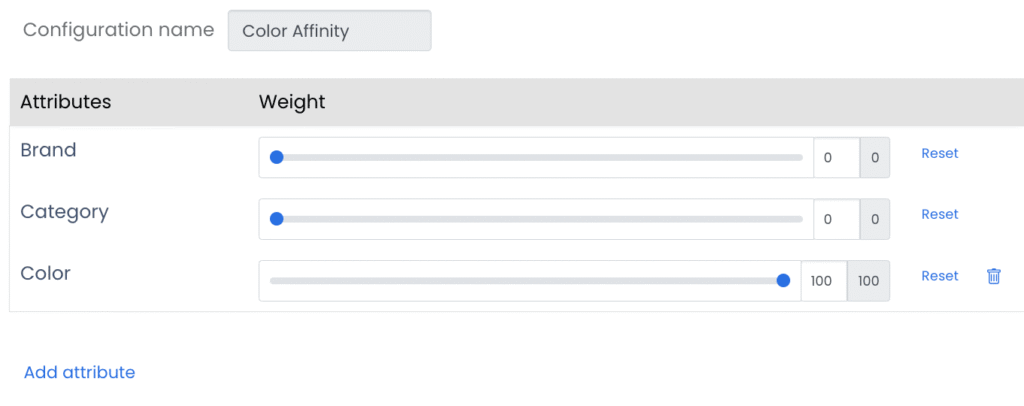
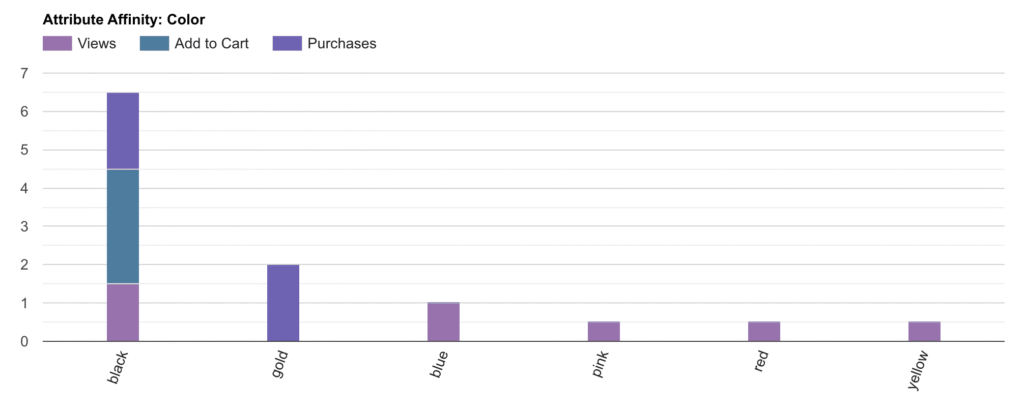
When a shopper interacts with the platform, their real-time customer profile (UPS) is analyzed to generate affinity scores for each defined attribute within the User Affinity Configuration. These scores are determined based on the products that the shopper has engaged with or purchased in the past.
In the example below from an apparel website, the shopper has a strong affinity toward black products and a medium affinity toward gold products.
To leverage the power of User Affinity Sorting in their recommendations, optimization managers can create custom strategies using Configurable Strategies. By selecting the User Affinity Sort option, recommended products can be re-ranked based on how well they align with the affinity scores for each shopper. This re-ranking process ensures that the products most closely matching a shopper’s affinity are given priority, allowing for a highly personalized ecommerce experience recommendations.
Also read: Why Consumer Electronics E-tailers are Betting Big on Commerce Personalization
Creating Multiple User Affinity Configurations
The flexibility of Recommend™ extends further by enabling the creation of multiple User Affinity Configurations, enabling optimization managers to focus on different product attributes of interest. For example, they can create one User Affinity Configuration centered around brand affinity and another focused on color.
Then, using Configurable Strategies, the optimization manager can specify which User Affinity Configuration is used for each strategy, allowing them to create different recommendation strategies that sort the recommendations based on differing affinity configurations. This allows for in-depth analysis and comparison of the performance and shopper response associated with each attribute.
In summary, Recommend™ empowers optimization managers to experiment with and compare various personalization strategies using User Affinity Sorting.
By leveraging User Affinity Configurations and Configurable Strategies, optimization managers can gain insights into the shopper base’s preferences and tailor personalized product recommendations based on specific attributes like brand or color.
Learn more about Recommend™ or request a demo to see the platform in action.