



TL;DR
Why isn’t a composable CDP enough for retail personalisation?
A composable CDP unifies customer profiles in the enterprise lakehouse. That is the right architectural move. But in retail, personalisation decisions also depend on product availability, store context, promotion mechanics, margin constraints, and consent status. Without a Retail Semantic Data Model that connects these entities in a shared business language, even the best composable CDP cannot power profitable, locally relevant, governed personalisation at scale.
Key Takeaways
- Composable CDP is necessary but not sufficient. It solves data unification, not decision quality.
- The missing layer is a Retail Semantic Data Model that gives business meaning to customer, product, store, inventory, promotion, margin, and consent data together.
- India/APAC’s omnichannel complexity (quick commerce, WhatsApp commerce, assisted selling, and DPDP compliance) makes this semantic gap especially costly.
- The semantic layer is also the governance layer: consent and permitted use must travel with every activation decision, not sit in a separate system.
This summary was created with AI and reviewed by an editor.

A Saturday Morning in Bengaluru
Priya is a Gold-tier loyalty member. Saturday morning, she walks into her neighbourhood store (a compact urban format, not a hypermarket) and picks up organic oats, Greek yogurt, and a promotion-discounted muesli.
Simple transaction. Except it isn’t.
Her basket is shaped by a health-conscious replenishment pattern the retailer can see across six months of purchase history. The muesli carries a category-level promotion inherited from a brand-funded trade deal, not a store-level markdown. Greek yogurt is in stock at this location but out of stock at the larger format store three kilometres away. And Priya has opted into app notifications but explicitly declined WhatsApp marketing under the retailer’s DPDP consent framework.
Now consider what the retailer’s systems need to know to make a single good decision about what to recommend, offer, or message Priya next:
Who she is (loyalty tier, household, lifecycle stage). What she bought (SKU, brand, category, basket composition). Where she bought it (store format, catchment, local assortment). What was available (inventory position, substitution options). What promotions were active (offer type, funding source, redemption rules). What her consent permits (channel eligibility, data-use boundaries). What the commercial objective is (margin target, category growth, basket expansion).
No single customer profile holds all of that. This is not a data-quality problem or a pipeline problem. It is a meaning problem. The data exists, often in the same lakehouse. But the connections between those entities, the semantic links, are missing.
Personalisation without availability is hallucination.
Personalisation without margin is a subsidy.
Personalisation without consent is a liability.
Explore Retail Semantic Data Model in Practice
The interactive widget below maps Priya’s shopping trip onto the semantic model, layer by layer. Start with the raw entities, then explore the product taxonomy and cross-entity inference that tells a retailer what to do next.
Cross-category rule — Breakfast products automatically suggest Dairy products as cross-sells. South India shoppers who buy Breakfast items also buy Dairy 78% of the time. This affinity is stored at the category relationship level, not per product.
Replenishment signal — two Breakfast SKUs in the same basket triggers a ~3-week replenishment reminder for both.
If you explored the widget, you likely noticed something: no single entity tells the full story. The insight only emerges when shopper context, basket composition, product taxonomy, store format, inventory position, and consent state are read together. That convergence is the semantic layer at work. A Retail Semantic Data Model is the business-language layer that sits on top of the composable lakehouse and gives consistent, queryable meaning to the full set of entities that drive retail decisions.
A Retail Semantic Data Model is not a schema exercise. It is the operating contract between every team and every algorithm that touches the customer.
What This Proves
Context Changes Meaning
Take organic oats as an example. The exact same SKU carries a different next-best-action depending on whether Priya is shopping in a compact urban store or a hypermarket. Store format determines assortment depth, substitution options, cross-sell candidates, and even whether a recommendation can be fulfilled. Remove store context, and the recommendation engine is guessing.
Meaning Can Be Inherited
The muesli discount Priya received did not originate at the store. It was a category-level promotion, funded by the brand, with rules that cascade from category to subcategory to qualifying SKUs. If a personalisation system stores rules only at the SKU level, it cannot see the promotion’s structure, cannot calculate cannibalisation, and cannot measure whether the trade investment achieved its objective. Category-level inheritance is where commercial logic lives in retail.
Insight Is Cross-Entity, Not Trapped in One Table
The inference that Priya is a high-value, health-conscious replenisher who could be nudged toward premium dairy (with a funded offer, fulfilled from current stock, sent via an app notification she has consented to) only emerges when you read across five entity types at once: shopper, basket, product, store, and consent. A customer profile, no matter how rich, is one table. The insight lives in the join.
What a Composable CDP Solves, and What It Does Not
A composable CDP builds unified customer profiles directly in the enterprise data warehouse, using modular, best-of-breed tools instead of copying data into a proprietary store. It preserves governance, avoids redundant data copies, and makes the lakehouse the system of data gravity. As architectural choices go, it is a sound one.
The composable foundation is no longer a debate. Most large enterprises have already integrated a data warehouse or lake with their martech stack, and the majority of those integrations are now bi-directional. It is becoming the default.
But composable architecture, by design, models the customer. It does not natively model what can actually be sold, fulfilled, substituted, promoted, or profitably recommended to that customer. The CDP Institute’s own definition (a system that creates a persistent, unified customer database) tells you where the boundary is.
Composable CDP
Pros
- Unified profiles
- Preserves governance
- Avoids redundancy
- Lakehouse gravity
- Bi-directional integration
Cons
- Lacks sales modeling
- Missing fulfillment data
- No promotion tracking
- No opt-out management
- Data exists, connections don’t
In retail, the customer profile is necessary. But it is not the whole decision. A grocery chain that knows Priya is a Gold-tier health-conscious shopper but does not know that organic oats are out of stock at her nearest store, that a funded muesli promotion expires tomorrow, or that she has opted out of WhatsApp. That chain cannot make a good next-best-action call. The data exists. The connections do not.
The composable CDP gives you the plumbing. The Retail Semantic Data Model gives you the meaning.
The Six Capabilities of a Semantically Complete Composable CDP
For retail enterprises, the composable CDP that delivers lasting advantage is not just architecturally open. It is semantically complete. That means six capabilities working together:
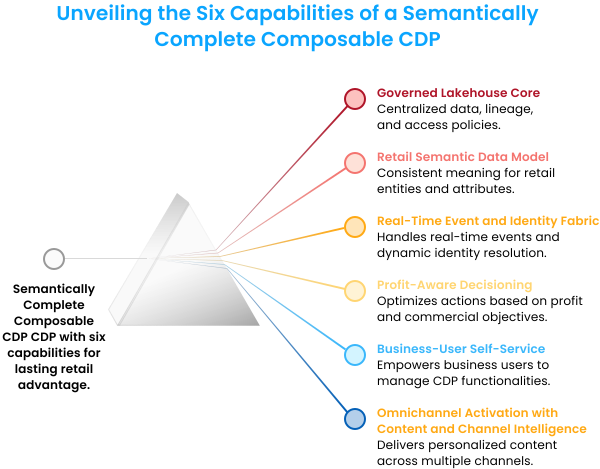

Governed Lakehouse Core
Data, lineage, access policy, and business definitions co-located in a single system of gravity. The composable architecture ensures nothing pulls the centre of gravity back out. Modern lakehouse platforms now support curated, trusted data-as-products with semantic consistency, operational synced tables for low-latency serving, and open sharing protocols for secure cross-platform data exchange.
Retail Semantic Data Model
Layered on top of the lakehouse, giving consistent meaning to the full range of retail entities. Not just customer attributes, but product hierarchies, store structures, inventory positions, promotion mechanics, loyalty logic, margin constraints, and consent states. This is the layer that makes the composable CDP retail-ready.
Real-Time Event and Identity Fabric
This goes beyond static profile resolution. It has to handle event fluency: replenishment signals, daypart shifts, search behaviour, geolocation triggers, and rapid intent decay in mobile and messaging channels. In grocery, replenishment windows are narrow. In QSR, daypart intent is fleeting. In WhatsApp commerce, wasted relevance is expensive.
Profit-Aware Decisioning
Actions ranked not just on customer propensity, but on stock, margin, offer cost, local conditions, and commercial objectives. The next-best action in retail must be customer-aware, stock-aware, store-aware, and margin-aware simultaneously. Research shows that even well-run grocers can expect 10 to 15 percent of promotions to dilute margins when these signals are disconnected.
Business-User Self-Service
Marketing, merchandising, and digital teams able to build audiences, define triggers, and launch journeys without engineering tickets. If composability only serves data engineers, the activation bottleneck simply moves downstream.
Omnichannel Activation with Content and Channel Intelligence
This is not just segment export. It is the ability to determine what to render, when to render it, and which channel to use, whether that is the app, web, email, store POS, or WhatsApp. The semantic layer makes this possible because it carries the context that channel selection depends on: consent state, store proximity, inventory position, and real-time intent.
DPDP and the Governance Equation
India’s Digital Personal Data Protection Rules, notified in November 2025, do not sit outside this argument. They are part of it.
The rules require itemised consent notices, purpose-based data retention, mechanisms for access, correction, and erasure, and breach notification within 72 hours. Penalties can reach ₹250 crore for failure to maintain reasonable security safeguards.
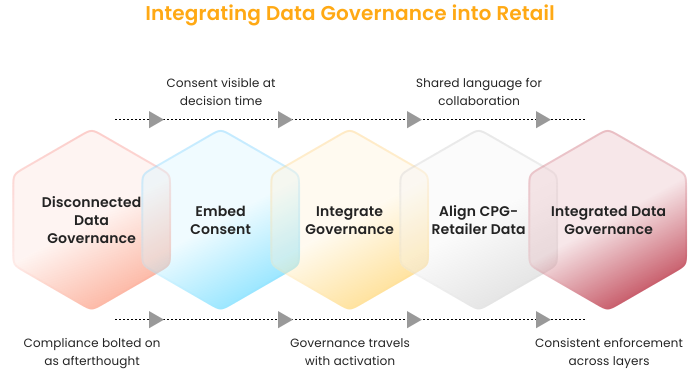
For retail enterprises, this means consent, access rights, and data-handling obligations must be embedded in the activation layer itself, not bolted on as a separate compliance system the marketing engine queries as an afterthought. When Priya opts out of WhatsApp marketing, that consent state must be visible to the decisioning engine at the moment it evaluates channel selection, not discovered after the message has already been queued.
The semantic layer is also the governance layer. Consent, eligibility, permitted use, and auditability must travel with every activation decision.
A retail semantic model that understands “active customer,” “eligible offer,” and “high-value segment” must also understand whether that customer has consented, what attributes are permitted to travel where, and what audit trail exists for any decision. In the composable architecture, this is not a limitation. That is a structural advantage: governance and intelligence in the same layer, enforced consistently.
For CPG brands, the same logic applies upstream. CPG-retailer collaboration increasingly depends on shared data, shared product language, and measurable demand-shaping across retailer, banner, region, store cluster, and promotion. The retail semantic layer becomes the language of collaboration: aligning offer history, funding logic, store-level activation, and outcome measurement across partners.
What This Means for the C-Suite
For the CIO
You have built the composable foundation. The next investment is not more infrastructure. It is the semantic layer that makes the infrastructure commercially intelligent. The question to ask your data platform and CDP partners: does the model natively understand retail entities beyond the customer profile? If not, every downstream activation is working with incomplete context.
For the CDO
Data quality and governance are your mandate. The semantic layer extends that mandate from data accuracy to data meaning. It is the layer where business definitions, consent states, and commercial logic converge, and where DPDP compliance becomes enforceable at the point of activation rather than in a separate audit trail.
For the CMO
Personalisation performance is your accountability. If campaigns cannot factor in store context, inventory, promotion economics, and consent, if every targeted offer still requires a two-week data-engineering ticket, then the composable architecture has not yet delivered its promise. The semantic layer is what closes that gap and turns the martech investment into measurable, margin-positive outcomes.
Where Retail CDP Strategies Usually Fail
The most common failure is not a technology failure. It is an assumption failure: believing that customer unification equals decision readiness.
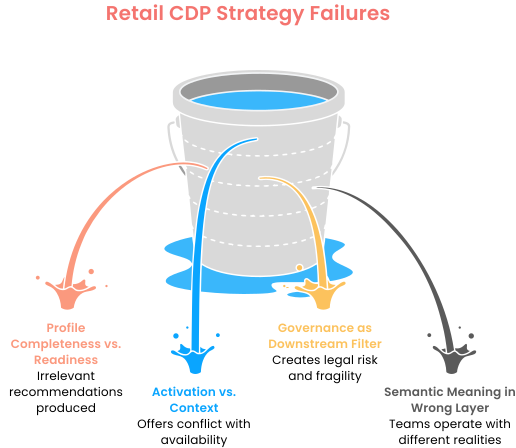
Trap 1: Confusing Profile Completeness with Decision Readiness
A rich, unified customer profile is valuable. But if the activation engine cannot access inventory, margin, or promotion context at decision time, the profile alone produces recommendations that are irrelevant, unprofitable, or impossible to fulfil.
Trap 2: Separating Activation from Merchandising and Store Context
When marketing activation operates in a silo, disconnected from merchandising calendars, store-level assortment, and inventory positions, the result is offers that conflict with what is actually available and promotions that erode margin rather than build it..
Trap 3: Bolting Governance On Later
Treating consent and data-protection compliance as a downstream filter, rather than embedding it in the decisioning layer, creates both legal risk and operational fragility. Under DPDP, this is no longer optional.
Trap 4: Storing Semantic Meaning in the Wrong Layer
When business logic lives in individual activation tools, BI dashboards, or campaign platforms rather than in a shared semantic model, every team operates with a slightly different version of reality. Category definitions drift. Promotion rules conflict. Store segmentation diverges. The semantic layer’s purpose is to be the single source of business truth.
The Bottom Line
Composable CDP architecture is the right structural foundation for retail. That question is settled. But architecture alone does not win in retail. What wins is the ability to turn a governed, composable data foundation into profitable, locally relevant, channel-aware, consent-compliant decisions at speed.
That requires a Retail Semantic Data Model: a shared business language, embedded in the composable architecture, that gives consistent meaning to customer, product, inventory, promotion, store, margin, and consent across every team and every AI system in the enterprise.
Composable was step one. Retail semantics is step two.
The question worth asking in your next data-platform review, your next architecture board, your next CDP partner evaluation:
If the answer is not yet, the architecture is ready. The semantic layer is the next move.
FAQs
1. What is a composable CDP in retail?
A composable CDP builds unified customer profiles directly in the enterprise data warehouse or lakehouse, using modular, best-of-breed tools. Unlike a traditional packaged CDP, it avoids copying data into a proprietary store, preserving governance and making the lakehouse the single system of data gravity. In retail, it is the preferred architectural foundation for customer data management.
2. Why is a composable CDP not enough for personalisation?
A composable CDP unifies customer data but does not natively model the other entities that retail decisions depend on: product availability, store context, promotion mechanics, margin constraints, and consent status. Without these connections, personalisation recommendations may be irrelevant (out of stock), unprofitable (margin-negative), or non-compliant (violating consent preferences).
3. What is a Retail Semantic Data Model?
A Retail Semantic Data Model is a business-language layer that sits on top of the composable lakehouse and gives consistent, queryable meaning to customer, product, store, inventory, promotion, loyalty, margin, and consent entities. It is the shared operating contract between analytics, marketing, merchandising, e-commerce, and AI systems.
4. How does store context change personalisation?
A Retail Semantic Data Model is a business-language layer that sits on top of the composable lakehouse and gives consistent, queryable meaning to customer, product, store, inventory, promotion, loyalty, margin, and consent entities. It is the shared operating contract between analytics, marketing, merchandising, e-commerce, and AI systems.
5. Why should promotion rules live at category level instead of SKU level?
Many retail promotions, especially brand-funded trade promotions, are structured at the category or subcategory level and cascade to qualifying SKUs. Storing rules only at the SKU level loses the promotion’s commercial structure, making it impossible to calculate cannibalisation, halo effects, or whether the trade investment achieved its objective.
6. How does a semantic layer improve next-best-action?
Next-best-action in retail requires reading across multiple entity types simultaneously: shopper context, basket composition, product taxonomy, store format, inventory, promotion eligibility, and consent. The semantic layer is what enables this cross-entity inference, turning fragmented data into a coherent, actionable signal.
7. What does DPDP change for Indian retailers?
India’s Digital Personal Data Protection Rules (notified November 2025) require itemised consent notices, purpose-based retention, access and erasure mechanisms, and 72-hour breach notification, with penalties up to ₹250 crore. For retailers, this means consent and governance must be embedded in the activation and decisioning layer, not managed in a separate compliance system.
8. Is this relevant outside India?
Yes. While India’s omnichannel complexity, WhatsApp commerce, and DPDP regulations make the semantic gap especially visible, the underlying argument applies globally. Any retail market with omnichannel activation, format diversity, promotion complexity, and data-protection requirements faces the same structural need for a semantic layer on top of the composable CDP.
Sources and Citations
CDP Institute: Industry definition and July 2025 update on composable CDP trends
Chiefmartec / Scott Brinker: March 2026 analysis of martech architecture and the composable canvas
Gartner: 2026 Predictions for Data and Analytics: universal semantic layers as AI infrastructure
McKinsey: Grocery analytics research on promotion dilution, personalisation uplift, and store-specific SKU selection
BCG and Retailers Association of India: India retail sector projections
Kearney: Quick-commerce grocery market growth projections (2024–2027)
USDA: India Retail Foods Annual 2025 (food-service market projections)
Meta and RAI: 2026 omnichannel findings: WhatsApp discovery, ROAS, omnichannel shopper spend
KPMG: India CX Report 2025
Object Management Group: ARTS Operational Data Model
GS1: Global Data Model for retail product attributes
Government of India / MeitY: DPDP Rules 2025; EY compliance summary