



Digital-first brands are not short of customer data. Product analytics, CRM entries, web and app behavior, campaigns, surveys, and billing systems all collect data, However, they are stored in different locations. When leadership asks simple questions, such as “Which customers are at risk right now?” or “Which journeys create the most expansion?”, the answers still require days of manual work.
The global customer data platform market was valued at approximately $5.4 billion in 2023 and is expected to surpass $51.95 billion by 2030, driven by the growing demand for first-party data, personalization, and AI-ready infrastructure.
Marketing teams continue to invest in tools, but decisions still rely on instinct and manual spreadsheet work. In a market where growth has slowed, and efficiency matters more than vanity metrics, that gap between raw data and actionable insights is becoming unsustainable.
One-third of companies in a recent HubSpot study reported direct revenue loss due to their customer data being scattered and disorganized, and only 9% stated they fully trust their data for reporting purposes. Salesforce research supports this, with 81% of leaders stating that data silos slow digital transformation.
This is the problem a real-time customer data management platform (rCDP) is designed to solve. rCDP creates a single, unified view of each customer and turns that view into real-time intelligence that any team can utilize.
Why More Customer Data isn’t Translating into Better Decisions
Every team views a different aspect of the same customer.

Marketing monitors campaign performance and lead scoring.

Product teams watch features, cohorts, and events.

Sales and account teams look for CRM opportunities and renewal dates.

Customer success relies on ticketing systems and NPS tools.
In theory, each function is working with data. In practice, they work with different subsets, stored in separate systems, each with its own fields and definitions. Reporting takes days of manual reconciliation. By the time a combined view is ready, the customer might be about to drop off.
From the customer’s perspective, this fragmentation is obvious. A prospect that is highly engaged in the product might still receive generic nurture emails. Loyal customers are sometimes treated like strangers because one platform has not synced with another. The problem is not a lack of data. It is the lack of a single, trusted customer data platform.
How Identity Resolution Turns Fragmented Data into One Customer Truth
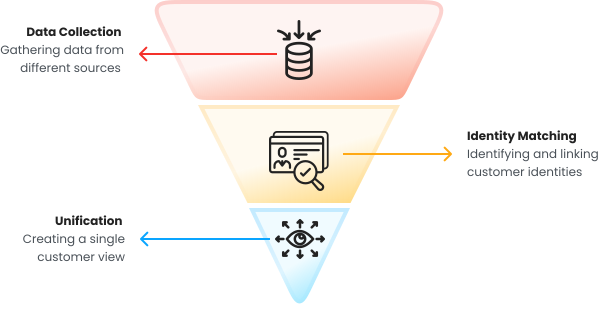
The first job of any credible customer data platform is identity resolution. One person might appear as a free trial user with a personal email address, a contact in CRM management with a corporate domain, a billing owner in the finance system, and an attendee in webinar tools. Without a unifying layer, each system treats them as a different person.
Algonomy’s platform applies deterministic and probabilistic matching techniques to stitch these fragments together into a golden customer record. That record contains demographic details, firmographic attributes, purchase history, channel preferences, consent flags, and summary metrics built from event streams.
How to Achieve a Unified Customer Profile with CDP
This unified customer profile does more than remove duplicate records. It becomes the shared language of the business. Product teams can identify which features are most important to high-value accounts. Marketing teams are aware of which channels each customer prefers. Finance and leadership can finally reconcile revenue numbers with actual engagement. Because the customer data management platform updates profiles as new events arrive, insights remain fresh, rather than being confined to static quarterly decks.
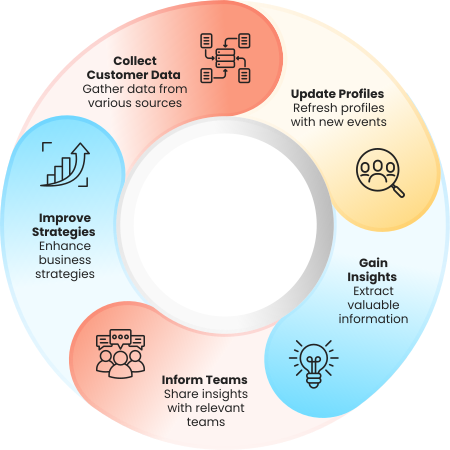
From Disconnected Events to Meaningful Segments and Insights
Raw data on its own rarely changes decisions. What teams need are segments, scores, and insights that prioritise where to act. A customer data management platform accelerates this step by enabling users to work directly with unified data, eliminating the need for engineering tickets.
With Algonomy’s platform, marketers and growth leaders can define audiences based on product behaviour, recency and frequency of usage, campaign interactions, lifecycle stage, predicted value, and more. The CDP’s artificial intelligence (AI) and machine learning (ML) capabilities help uncover micro segments that would be hard to spot manually, such as clusters of customers who respond strongly to a certain offer or who tend to expand into a specific module next.
When segments and insights live inside the customer data platform, they are not just reports. They are live objects that journeys and campaigns can use immediately.
To learn more, read 5 Must-have Spells for Mastering Audience Engagement with CDP
Activating Insights Across Every Customer Touchpoint
Insight only matters when it transforms customer experience. A stellar customer data platform connects unified profiles and segments to every important touchpoint. Algonomy’s customer data platform plugs into email service providers, mobile push and SMS tools, digital advertising platforms, contact centers, kiosks, websites, and apps through out-of-the-box connectors.
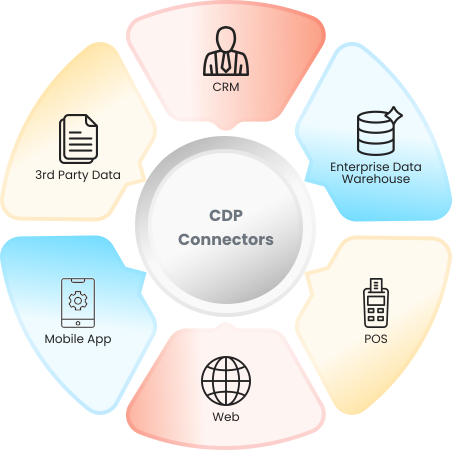
As the platform analyzes new events in real-time, it can trigger journeys the moment something meaningful occurs.
 A trial user who reaches a key feature milestone can enter a tailored sequence.
 A paying customer whose usage drops can enter a save journey that blends in product nudges, targeted offers, or human outreach.
 When a customer shows a strong affinity for a set of products, relevant recommendations and offers appear consistently across email, app, and site, rather than as disconnected messages.
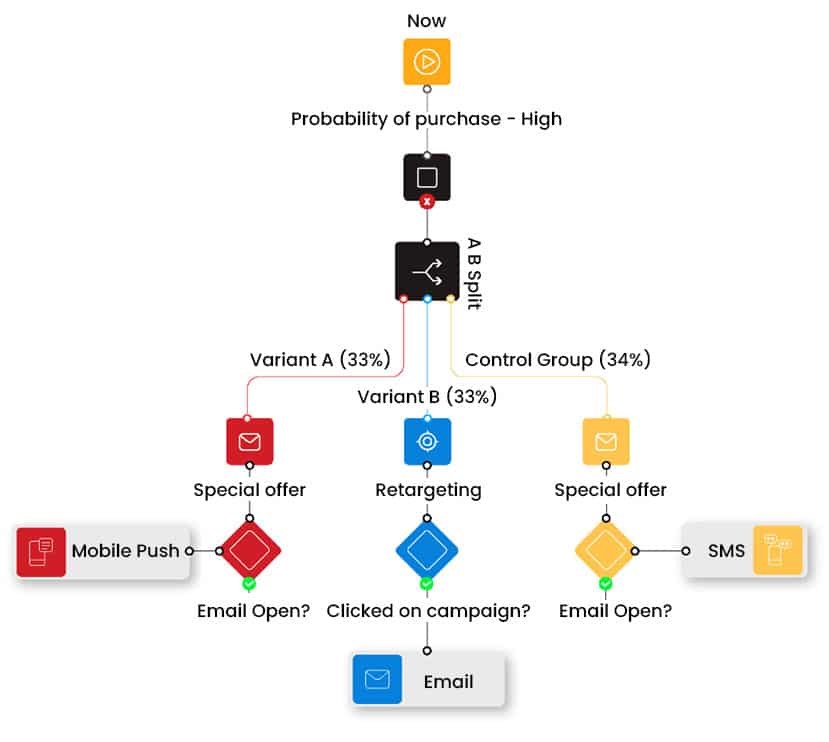
At McDonald’s India, Algonomy’s customer data management platform and customer journey orchestration solution allowed the brand to create automated journeys for weekly promotions, frequency building, McDelivery penetration, and win-back strategies. This automation ran across SMS, email, Facebook, and WhatsApp, with A/B tests and universal control groups to measure impact.
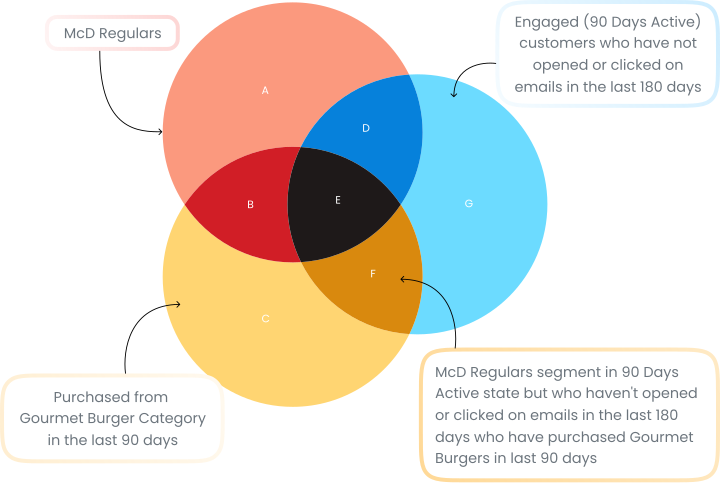
Algonomy’s platform helped McDonald’s in creating microsegments to design winback campaigns
Why Successful Marketing Teams Leverage a Customer Data Platform
The value of a customer data platform becomes most clear when examining specific outcomes. A few high-impact scenarios stand out across Algonomy’s customer base.
 Intelligent onboarding and activation
By combining acquisition source and early product behavior, the rCDP platform identifies the actions that correlate with long-term retention. Marketing teams can then design onboarding flows that guide each customer through those actions, rather than a generic checklist. Product and account qualified lead scoring
Instead of static scores that live only in CRM, an rCDP recalculates scores whenever important events occur. Sales can focus on the highest intent accounts, while marketing uses similar signals for lookalike audiences and retargeting. Retention, win back, and expansion
Signals such as declining usage, negative feedback, or repeated support tickets feed into churn propensity models. The rCDP uses those models to trigger save plays, offer adjustments, or success outreach before it is too late. Cross-sell and expansion journeys
Unified profiles and basket analysis models highlight the next best product, module, or package for each customer. Journeys can then present these in a sequence rather than relying on a one-off campaign. Scalable Omnichannel Engagement
McDonald’s (West & South India) deployed Algonomy’s customer data platform, customer journey orchestration, and marketing services to centralise customer data management across delivery apps, aggregators, and physical stores. This unified view enabled granular segmentation and automated campaigns across six channels, creating more than:
44%
Million Engagement Opportunities
45%
Growth in Omnichannel Customers
33%
YoY Increase in McDelivery Users
“The CDP and Customer Journey Orchestration projects were key to McDonald’s India’s digital and data transformation journey, whereby we were able to build capabilities to drive insights-driven marketing across channels. We deeply appreciate the invaluable assistance provided by Algonomy’s analytics and campaign specialists, who have worked closely with us to develop and optimize our campaigns.”
– Arvind R P CMO, McDonald’s India
How to Evaluate a Customer Data Platform That Delivers Business Impact
Once the business case is established, the next step is selecting the right customer data platform. Drawing on industry research and Algonomy’s experience with over 400 brands, the following criteria can guide your decision.
Strong data management foundation
Look for flexible ingestion options, such as batch files, real-time APIs, and clickstream capture, along with robust cleansing, enrichment, and identity resolution. Algonomy’s platform supports deterministic and probabilistic matching, household creation where relevant, and enrichment from third-party sources.
Audience building and analytics for business teams
An effective CDP enables marketers, product managers, and CRM teams to easily build segments, apply AI-based models, and analyze performance over time without heavy engineering support. The interface should function as a workspace rather than a back-office tool. Algonomy’s platform combines Audience Manager, built-in analytics, and AI/ML models for affinity, churn propensity, and replenishment, making advanced segmentation accessible.

Clustering Model

RFM based Audiences

Churn Propensity

CLTV Model

Propensity

Replenishment

Affinity Model

Lookalike Model

Market Basket Analysis
Activation and journey orchestration
Algonomy’s platform should integrate easily with existing channels and orchestration tools. It should provide capabilities for audience export, triggered journeys, and rule-based flows that work across email, mobile, digital advertising, and on-site experiences. Algonomy’s platform integrates journey orchestration and personalization, enabling teams to transition from insight to experience without needing to build custom connectors for every idea.
Security, privacy, and governance
Finally, any platform that handles customer data management must prove its approach to privacy, consent, and security. This includes support for regional regulations, access controls, and clear auditability. Many marketing leaders say that management of first-party customer data in a way that balances privacy and value exchange is becoming increasingly challenging, so the CDP must help rather than add risk.
When evaluating options, it often helps to run a pilot that connects a few key sources, delivers one or two priority use cases, and measures impact. That reveals how well the platform works with your existing stack and teams in practice, not just in slideware.
Future-proofing Your Data Strategy With CDP
The next wave of growth in SaaS and retail will belong to companies that treat customer data management as a strategic asset rather than a byproduct of operations. AI, predictive models, and automated agents will amplify this difference. Models are only as good as the data they are trained on. If that data is scattered, stale, or poorly governed, the promise of AI-driven personalization and efficient growth will remain out of reach.
A customer data platform is not a magic wand, but it is a practical way to build solid foundations. By unifying customer data into trusted profiles, surfacing actionable segments and insights, orchestrating journeys across all channels, and closing the loop with measurement, a CDP turns the idea of customer centricity into an operational reality.