
Commerce Unlocked #7: One Stack for Retail AI: From transactional planning to agentic intelligence built natively on Databricks. Register Free →


Commerce Unlocked #7: One Stack for Retail AI: From transactional planning to agentic intelligence built natively on Databricks. Register Free →
Algonomy is now part of ADA, creating the world’s most intelligent growth platform for enterprises globally. Learn More

Email still does something most channels struggle with. It reaches customers directly, at scale, in a format that sells, educates, and retains. Yet many retail emails still feel like flyers. They often display outdated prices, items the customer has already purchased, and designs aimed at groups rather than individuals.
The solution isn’t sending more emails. AI helps marketers create and adapt content faster, generating images, banners, and creative variations for use across personalized email experiences.
It’s using AI email personalization to make each open feel relevant, not static. When personalization goes beyond just names or segments, email becomes more like your website: responsive, contextual, and always up to date.
This guide explains what true personalization means today, how it affects revenue, and how a solution like Active Content enables marketers to send dynamic, real-time emails.
Most marketers are not short on ideas. What slows them down is timing and execution.
Email content is usually set before sending. Creative gets approved, products are chosen, and offers are fixed. But customers might open those emails hours or days later, when things have changed. Prices may differ, items may be out of stock, or customer interests may have shifted.
This gap is easy to spot. Customers click through and find different prices or out-of-stock products. They leave the process, and over time, lose trust in email as a reliable channel.
When this happens, the website has to fix the problem by showing the correct price, availability, or products. This means the email didn’t do its job and instead made the process harder for the customer.
Email shouldn’t be a static message. It should show what’s available and relevant when the customer opens it.
This is why dynamic email content and open-time rendering matter. They let the email update its content when opened, not just when sent, so customers see the latest information instead of outdated details.
Most marketers already understand the importance of relevance. The real limitation is that email is often created too far in advance. By the time it is opened, the context has moved on. Inventory changes, prices update, reviews increase, and customer behavior evolves. If the email cannot adjust, it loses value at the exact moment it needs to perform.
Active Content is designed to solve this problem by enabling AI email personalization across channels. It creates dynamic content that brings in the latest, most relevant information when the customer interacts. This makes email more accurate, useful, and effective for driving revenue.
Segment-level personalization can help, but it has some limits:

Customers within the same segment still have different preferences and intent.

Price, stock, and offers change too fast for a segmented creative.

Teams overproduce variants, increasing the workload and slowing time-to-market.
Active Content addresses these limits by combining dynamic templates with AI-assisted content creation. Instead of manually designing multiple versions of the same email, marketers can use AI to generate and adapt creative elements that fit different contexts. One dynamic template can then reuse these assets across customers, reducing production effort while keeping content fresh and relevant.
AI email personalization means choosing the most relevant message, offer, and products for each customer, and showing them what’s true at that moment.
This definition matters because it goes beyond basic segmentation. AI email personalization is not only about deciding who receives an email, but also about making it easier to create and maintain personalized content. Active Content uses generative AI-assisted content creation to help marketers generate images, banners, and creative elements using prompts. This allows teams to build, refresh, and scale personalized email content without heavy dependence on design or production resources.
Decisioning: Choosing what content should appear based on customer intent and likelihood to act. This layer can use AI-driven predictive insights, such as propensity, churn risk, and replenishment timing, alongside business rules, such as margin thresholds, inventory limits, and exclusions. These insights typically come from CDPs or recommendation systems and guide what content is eligible to be shown.
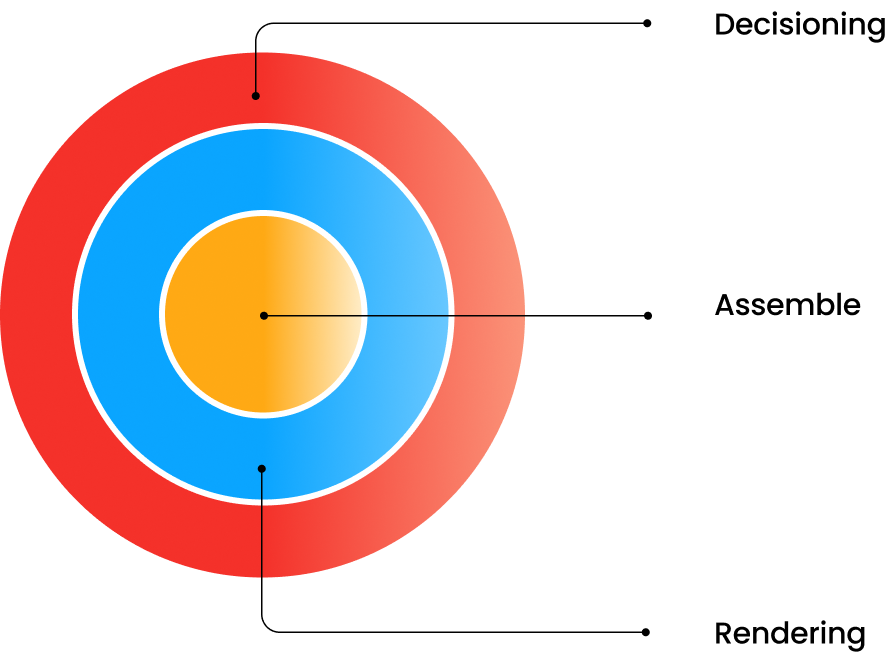
Assembly: Building emails from modular blocks so one template can create many versions. Active Content uses generative AI-assisted content creation to help marketers generate and adapt images, banners, and visual elements using prompts. This speeds up the creation of reusable blocks and reduces the effort needed to maintain multiple creative versions.
Rendering: Ensuring the email reflects current information when it is opened. Price, availability, offers, ratings, and store location can all be updated in real time at open. This layer focuses on accuracy and freshness,
Relevance isn’t just about branding. It drives conversions. When a customer opens an email and sees content that matches their intent, three things happen quickly:
In retail, these small improvements add up to results that matter to leadership, like higher revenue per email, more repeat purchases, and better returns on production costs.
This is why you should measure a personalized email campaign beyond just opens and clicks. If personalization works, you’ll see better conversion rates, bigger basket sizes (when relevant), and stronger list quality over time.
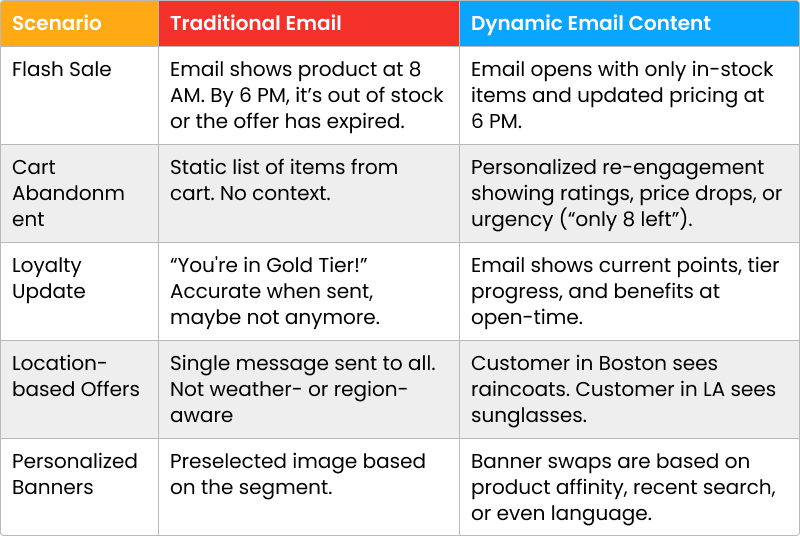
Behind dynamic email content is a shift in how creative is produced. AI-assisted content generation makes it easier to create and refresh images, banners, and visual elements as conditions change. This allows teams to maintain dynamic campaigns without rebuilding creative from scratch.
When you’re looking at email personalization platforms, the key question isn’t “Can it personalize?” Most platforms say they can. The real question is:
Here are the criteria that separate a scalable solution from a short-term experiment.
If price, stock, offer windows, or social proof are central to conversion, the email must update when it is opened.
Personalization is usually handled by multiple systems. Your customer data might be in a CDP, product data in your commerce platform, offers in a promotions tool, and loyalty status in another system. Your platform should seamlessly connect and combine all these data points.
No-code and low-code controls are not nice-to-haves. They determine whether personalization becomes an always-on capability or a quarterly project.
Look for a block library approach with fallbacks, quality checks, and safe defaults. Enterprise teams need repeatable solutions, not one-off custom builds.
Active Content works between your data sources and your email service provider. It doesn’t replace your ESP. Instead, it controls what content shows up in the email when it’s opened.
Your ESP still manages audience selection, journeys, and sending. Active Content controls the dynamic elements inside the email, such as product displays, pricing, availability, offers, and loyalty information. Generative AI-assisted content creation helps marketers generate and modify creative assets using prompts, reducing the effort required to build and update these dynamic elements. Because the content is assembled at open time, it remains current while production stays manageable.
This approach reduces manual updates, reduces rework when things change, and lets one email template serve many customers with different content. The result is a personalized campaign that stays accurate, scales easily, and is simpler for teams to manage.
Instead of trying to personalize everything, start where customers are already interested. Cart recovery, browse abandonment, back-in-stock alerts, post-purchase cross-sell, replenishment reminders, and loyalty nudges are great places to begin. The demand signal is already there. Personalization simply reduces friction.
The shift is moving from creating many versions to creating adaptable content. With Active Content, marketers design modular blocks and use AI to generate or adjust creative elements within those blocks. This allows a single template to serve different audiences without requiring repeated design work or manual updates.
This is when the email stops feeling like a scheduled blast and starts acting like a responsive storefront. When opened, it can show the latest price, if a size is still available, if a promotion is running, or if the customer has reached a loyalty milestone.
For shoppers, this accuracy builds trust. For marketers, it means fewer campaign pauses when things change after sending.
Active Content plugs into existing email production. Your ESP still manages journeys and sends, while Active Content handles the dynamic parts inside the email. This lets you modernize without replacing your automation system.
A personalized email campaign should be measured with both performance and caution.
In addition to performance metrics, teams should measure the operational impact of Agentic AI. Metrics such as time to launch, the number of creative iterations, and reliance on design resources help demonstrate how AI enables faster execution and more scalable personalization.
What could better embody the essence of advanced content personalization software in action than Active Content?
Active Content enables real-time,tailored-to-customer experience using a visual workflow connecting live data sources like recommendation engines, loyalty systems, or APIs. With it, marketers can create one campaign and numerous variations that automatically personalize for each recipient based on their most recent behavior, location, loyalty tier, or even product inventory status.
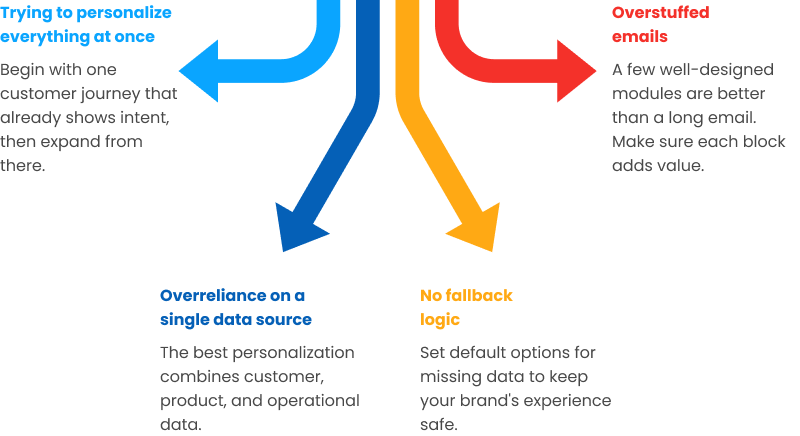
If you already have an ESP and customer data, you’re closer than you think. The next step is to make personalization easier to implement. Active Content uses Generative AI-assisted content creation to help marketers generate and adapt creative assets quickly, while dynamic, open-time content ensures accuracy. Together, this allows teams to modernize one journey at a time without increasing production complexity.
Start with cart or browse abandonment. Build one flexible template. Use open-time rendering for fast-changing elements. Measure revenue per email against a static control. Once you see improvement, you can confidently scale to the rest of your lifecycle program.












Let’s face it—customers nowadays expect deeper and relevant communication, not cookie-cutter-styled messaging across every channel.
Deliver a best-in-class customer experience, increase online sales, and drive operational efficiency at scale

AI-powered social proof that reads every context and serves what converts.