
Commerce Unlocked #7: One Stack for Retail AI: From transactional planning to agentic intelligence built natively on Databricks. Register Free →


Commerce Unlocked #7: One Stack for Retail AI: From transactional planning to agentic intelligence built natively on Databricks. Register Free →
Algonomy is now part of ADA, creating the world’s most intelligent growth platform for enterprises globally. Learn More
Publish Date: January 7, 2026
The collaboration empowers retailers with industry-leading agentic AI for end-to-end retail planning, enabling faster and more reliable data-driven decision making, higher planning efficiencies, and delivering measurable business outcomes at scale on a governed data foundation
Algonomy is a global leader in retail-centric marketing and planning solutions with a proud history of more than twenty years, serving 500+ global brands. Algonomy, as the name suggests, is one of the earliest solution providers to adopt an AI-first solution strategy, which is built on retail-specific proprietary algorithms and data models. It has further strengthened its position as an AI-first solution provider with RetailAI, a suite of agentic solutions focused on retail planning.
RetailAI provides agentic solutions to retailers for demand forecasting, demand sensing, replenishment planning, allocation, promotion and price optimization, assortment planning, scheduling, logistics planning, operations planning, and space planning. It transforms traditional GUI-driven user interactions to conversational user interactions, which are powered by agentic AI, deep learning, and machine learning technologies.


While modern technologies such as machine learning, deep learning, generative, and agentic AI remain at the very core of Algonomy solutions, it firmly recognizes the need to create business impact through clearly measurable outcomes. According to them, in the absence of clear business outcomes, any technology will become obsolete over time, no matter how transformative it may be. Algonomy’s products are designed, and customer engagements are shaped with this guiding principle at the forefront.
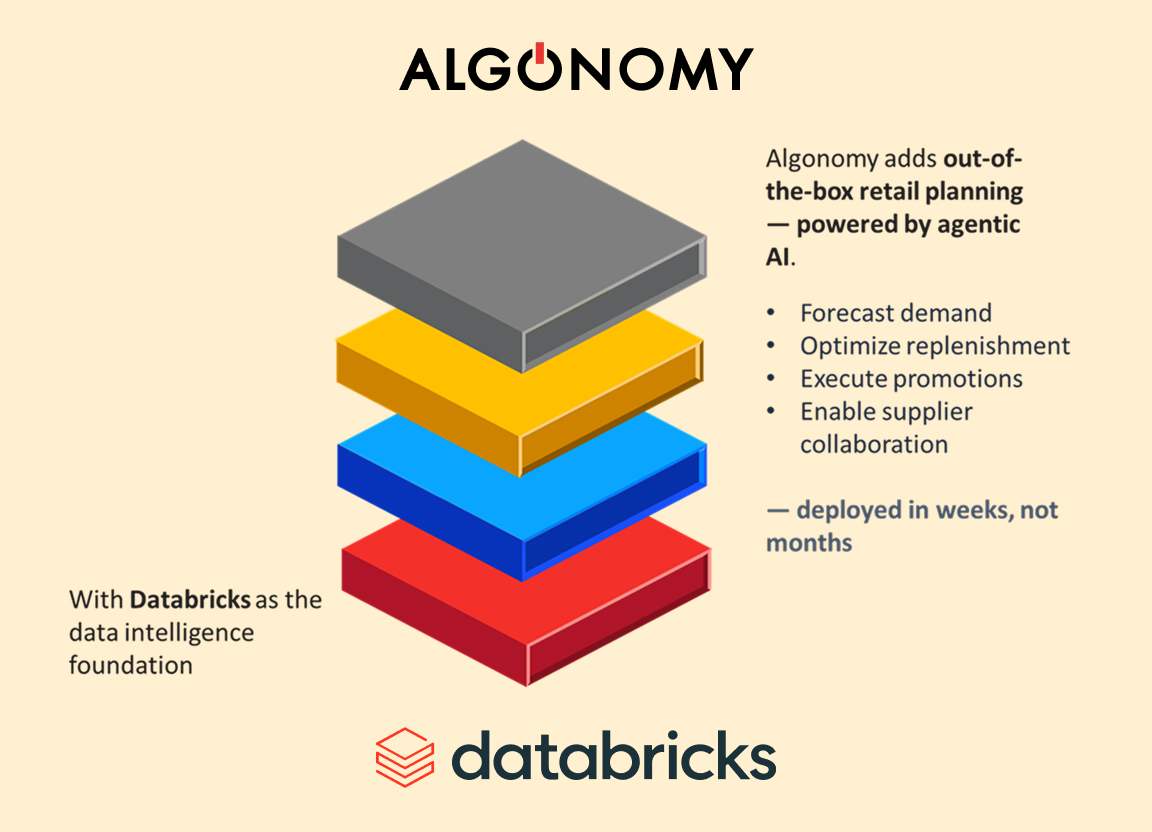
As a Built-On Databricks partner, Algonomy and Databricks share a common belief: great AI is only possible when great data, strong governance, and production-grade AI models come together at scale. RetailAI is an AI-native retail intelligence and planning platform, purpose-built for complex retail use cases. At its core are Algonomy’s proprietary retail algorithms, retail-specific data models, and out-of-the-box insights — accelerating time to value for retailers while reducing the ROI risk associated with large-scale AI initiatives.
RetailAI is built natively on the Databricks Data Intelligence Platform, leveraging Apache Spark™, Photon, Mosaic AI, MLflow, and Unity Catalog to deliver governed, scalable predictive, prescriptive, and agentic AI. AI/BI Genie and Agent Bricks power conversational and agentic planning experiences, while seamless integration with SAP Business Data Cloud through Databricks enables ecosystem connectivity without data duplication. Together, Algonomy and Databricks enable retailers to move from data to decisions faster — combining retail-grade AI, trusted data foundations, and enterprise-scale performance in a single, unified platform.

Chief Business Officer, Algonomy.

Databricks’ Head of Partner Ecosystems for Consumer Industries
Algonomy and Databricks will showcase the next generation of RetailAI at NRF 2026: Retail’s Big Show, with Algonomy joining Databricks in Booth #6429 (Level 3) for a dedicated session on Agentic Retail Planning, natively built on the Databricks Data Intelligence Platform. The joint session will showcase how Algonomy’s Agentic Retail Planning Software Built On Databricks has revolutionized retail planning workflows on demand forecasting, demand sensing, replenishment planning, allocation, promotion and price optimization, assortment planning, scheduling, logistics planning, operations planning, and space planning.
The joint NRF session will be held on January 13, 2026, from 11:00 AM to 12:30 PM ET at the Databricks Booth #6429, where attendees can see live demonstrations and discuss roadmaps with both Algonomy and Databricks experts.
Let’s face it—customers nowadays expect deeper and relevant communication, not cookie-cutter-styled messaging across every channel.
Deliver a best-in-class customer experience, increase online sales, and drive operational efficiency at scale

AI-powered social proof that reads every context and serves what converts.